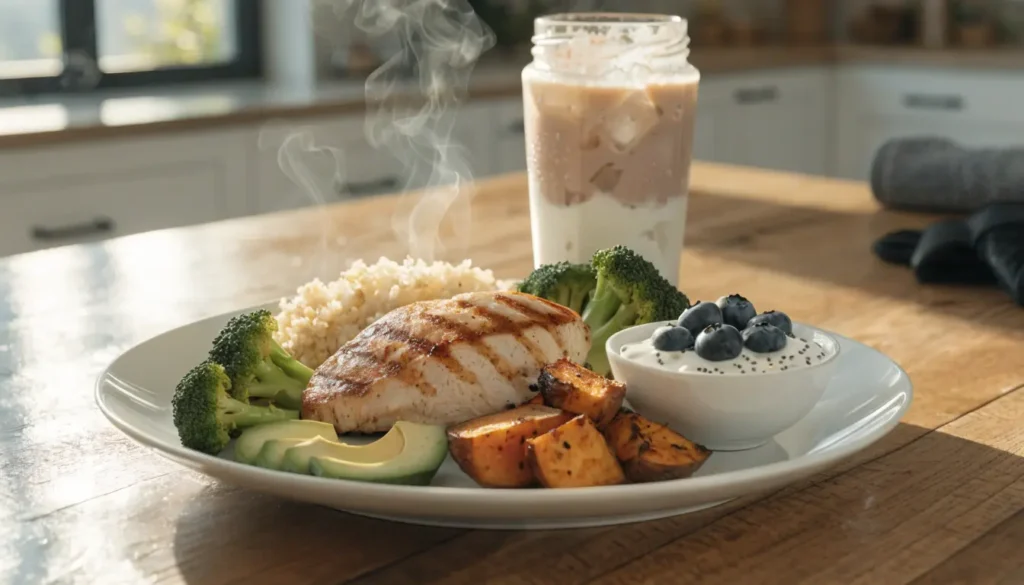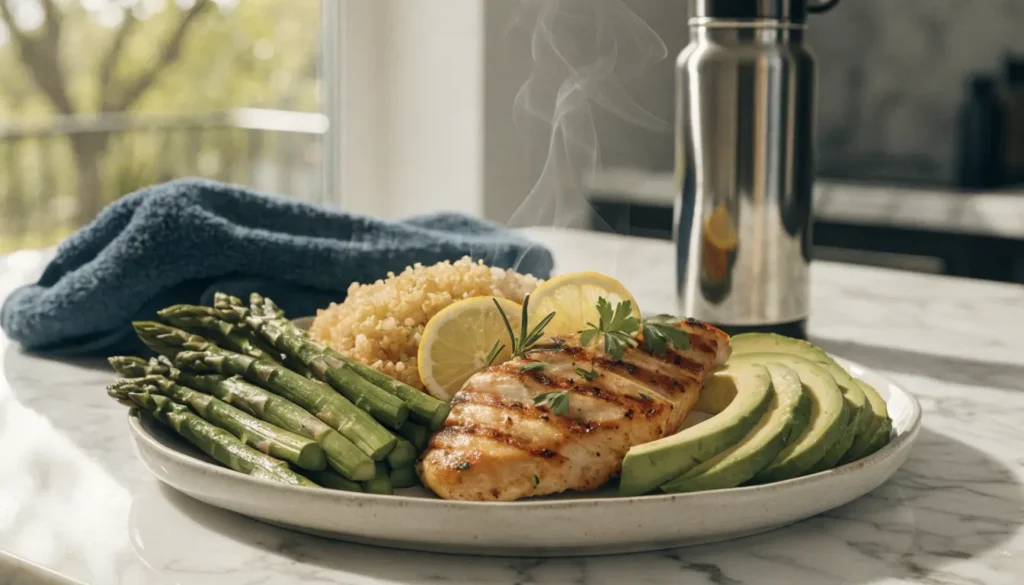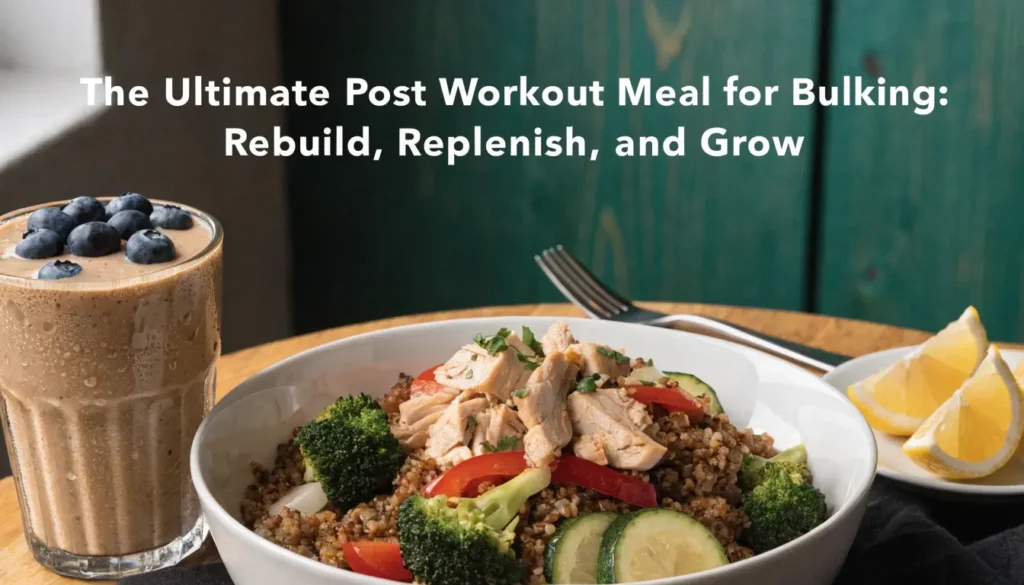
You just crushed your workout. The weights are racked, the treadmill is cooling down, and your muscles have that beautiful, swollen pump. But instead of feeling proud, you feel a familiar knot of anxiety twisting in your stomach.
Where is my protein shake?
For two whole years, I lived like that. Chasing a stopwatch. Sprinting to my kitchen before I even toweled off. I once ignored three calls from my mom because I was convinced that if I didn’t chug 40 grams of whey within nineteen minutes, my biceps would literally shrink back to toothpicks. Looking back, I was miserable. The stress of the clock was stealing the joy of the workout.
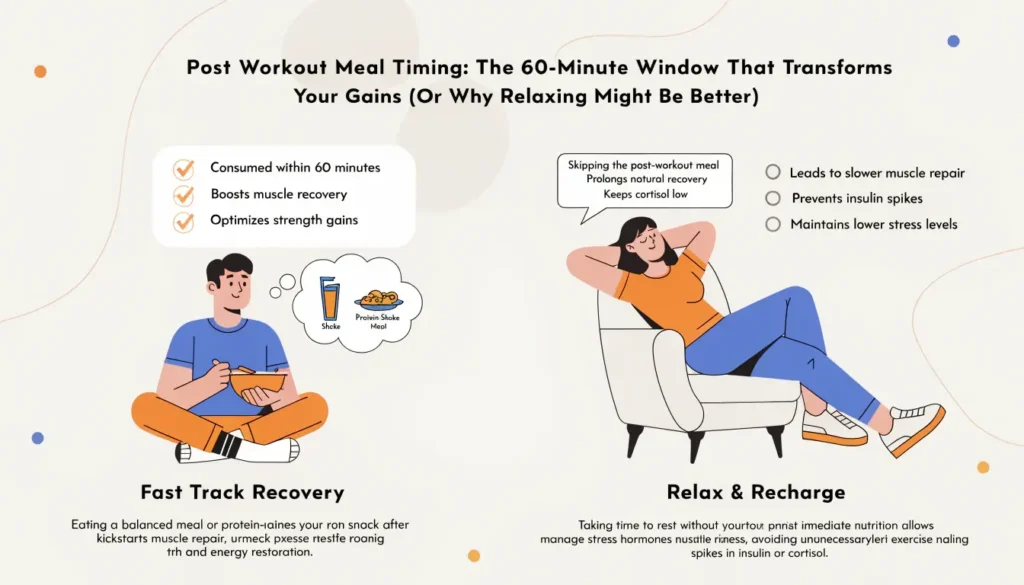
Here is the truth you need to hear: You can relax.
But—and this is a big but—you can only relax if you understand the rules of the game. The science of post workout meal timing has shifted dramatically in the last five years. We are moving past panic and into precision. In this guide, you will learn exactly when to eat, what actually happens inside your cells during that “golden hour,” and why sometimes, taking a shower before you eat is actually the smarter move.
Take a deep breath. Let’s fix your relationship with the kitchen clock.
What Is “Post Workout Meal Timing”? (And Why Your Gym Buddy Is Wrong)
Let’s clear the air immediately. When someone yells, “You better eat now or you’ll lose the pump,” they are operating on information from the 1990s.
Post workout meal timing refers to the strategic window of time following physical exertion where your body is most receptive to nutrients. It is the difference between throwing hay at a barn door when it’s wide open versus when it’s already latched shut.
The Anabolic Window vs. The Barn Door Theory
You have probably heard of the “anabolic window.” Bodybuilding magazines treated this window like a bank vault door that slams shut after 30 minutes. If you weren’t inside, you lost your gains forever.
Modern sports nutritionists call this the “Barn Door” theory instead.
- The Old Myth (The Vault): You have 30–45 minutes. If you miss it, you might as well go home and eat pizza because your muscles won’t absorb anything.
- The New Science (The Barn Door): Research published in the Journal of the International Society of Sports Nutrition (2022) suggests the door is actually open for 4 to 6 hours. However, it is widest open during the first two hours.
Think of it like wet clay. You have hours to mold it, but the first sixty minutes are when the clay is softest and easiest to shape. You do not need to panic, but you also should not wait four hours to watch Netflix first.
Who Actually Needs Strict Timing?
Here is where you need to be honest with yourself. Not everyone needs to eat like an Olympian. Let’s break down who should watch the clock like a hawk versus who can take a leisurely stroll to the fridge.
You need strict post workout meal timing if:
- You train twice a day (morning and evening). Your glycogen tanks are empty.
- You are over 40 years old. Your body suffers from “anabolic resistance,” meaning you need nutrients sooner to trigger repair.
- You are a competitive bodybuilder prepping for a show.
- You train completely fasted (first thing in the morning without breakfast).
You can relax the timing if:
- You ate a meal 2 hours before your workout.
- You are just walking or doing light yoga.
- Your main goal is general health, not maximum muscle hypertrophy.
The Golden Hour: Breaking Down The 60-Minute Rule
Let’s zoom in on the most stressful part of your day: the drive home from the gym. You are sweaty, tired, and hungry. Why does that 60-minute rule keep popping up on every fitness website?
Because that is when your biology is screaming for help.
What Happens at Minute 0, 30, and 60
Imagine your muscles are a dry sponge. When you lift weights or sprint, you squeeze all the water (glycogen) out of that sponge. You also create microscopic tears in the sponge fibers.
- Minute 0–15 (The Panic Phase): Your cortisol levels are spiking. Cortisol is a stress hormone that breaks down tissue. You are technically in a catabolic (breaking down) state. This sounds scary, but it is normal. It is the signal that says, “We need fuel now.”
- Minute 30–60 (The Prime Phase): Blood flow to your working muscles is at its peak. Think of this as the delivery trucks having a clear highway. If you eat protein now, it gets to the construction site faster than any other time of day.
- Minute 90+ (The Slow Decline): The construction workers start to go home. If you haven’t given them bricks (protein) and wood (carbs), your body starts scavenging fuel from your muscle tissue. You are literally burning muscle to feed your organs.
Hard Data You Can Trust
A landmark study by Dr. John Ivy back in 2004 (still cited today) looked at cyclists who ate a protein-carb mix immediately after training versus those who waited two hours. The results were staggering.
The Finding: The group who ate within 60 minutes stored 300% more glycogen in their muscles than the group who waited two hours.
That is not a typo. Three hundred percent. If you want to feel strong tomorrow morning, you need to get those carbs and protein in during that first hour.
What To Eat Inside The Window (It’s Not Just Protein)
You have your phone timer set for 55 minutes. Now what? Do you just chug a protein shake and call it a day?
No. You are leaving massive gains on the table if you skip carbohydrates here.
The Macro Ratio Cheat Sheet
You need three things: Protein to repair the muscle, Carbs to refill the fuel tank, and very little fat to keep the train moving fast.
The Formula for a 180-pound lifter:
- Protein: 30–40 grams (0.4–0.5g per kg of body weight).
- Best sources: Whey isolate (digests in 20 minutes), grilled chicken, Greek yogurt.
- Carbohydrates: 30–60 grams depending on how hard you trained.
- Best sources: White rice (yes, white is better than brown here because it digests faster), a ripe banana, or Gatorade powder.
- Fats: Keep it under 10 grams.
- Why: Fat slows down gastric emptying. If you eat a cheeseburger right now, the fat will act like a traffic jam, and the protein will take hours to reach your muscles.
A quick note for endurance athletes: If you ran a 10k, you want a 3:1 or 4:1 ratio of carbs to protein. If you just did heavy bench pressing, a 1:1 ratio is fine.
The Hydration Factor
Nobody talks about water, but it is the truck that delivers the nutrients. You cannot rebuild muscle in a dehydrated cell.
The scale trick: Weigh yourself naked before you work out. Weigh yourself naked after you work out (towel off the sweat first). For every pound you lost, drink 16 to 24 ounces of water.
Pro tip: Add a pinch of salt or an electrolyte tablet to your post-workout shake. You sweat out sodium, and sodium helps you hold that water inside the muscle where it belongs.
Does Fasted Training Change Post Workout Meal Timing?
Let’s talk about the 5 AM crew. You roll out of bed, drink black coffee, and hit the gym on an empty stomach. This is called fasted training, and it changes every rule we just discussed.
The Fasted Athlete’s Risk
When you train fasted, your blood amino acid levels are zero. Your liver glycogen is low. You are essentially asking your body to build a house with no bricks on the site.
If you do this, your post workout meal timing window shrinks from 60 minutes to 30 minutes.
You do not have a four-hour barn door. You have a 30-minute window. If you wait 90 minutes to eat after fasted lifting, you will experience significant muscle breakdown.
The “Leucine Threshold”
Leucine is the trigger. It is the specific amino acid that flips the switch for muscle protein synthesis (MPS). If your meal does not have enough leucine, the construction crew never gets the signal to start working.
You need 2.5 to 3 grams of Leucine in that first meal.
Here is how to get it fast after a fasted workout:
- Whey Protein Shake (fastest): One scoop gives you roughly 2.5g of leucine.
- Four whole eggs + half a cup of white rice: Slower digestion, but effective.
- Tuna pouch (the lazy winner): Open it, eat it with a fork in the locker room. No cooking required.
Late Night Workouts: Eating Before Bed Without Gaining Fat
You work late. You have kids. The only time you can train is 8:30 PM. Now you are standing in your kitchen at 9:45 PM staring at the refrigerator, terrified that eating will turn into belly fat by morning.
The Sleep vs. Satiety Paradox
Here is the science that will set you free: The thermic effect of food (TEF) works exactly the same at 10 PM as it does at 12 PM. Your metabolism does not have a curfew.
However, digestion is active. If you eat a huge, greasy meal right before you lie down, your body will struggle to digest it. You will have nightmares, acid reflux, and poor sleep quality. Poor sleep does cause fat gain.
Best Night-Time Post Workout Meal
You need slow-burning protein to feed your muscles while you sleep, but not so much bulk that you feel like a beached whale.
- Go for this: 1 cup of cottage cheese (casein protein) mixed with a handful of berries. Casein clots in your stomach and releases amino acids slowly over 6-8 hours.
- Avoid this: A cheeseburger, french fries, or a 40-gram sugar-laden mass gainer.
- Timing trick: Eat your meal 60 to 90 minutes before you put your head on the pillow. Give your stomach a head start.
3 Common Post Workout Meal Timing Mistakes Sabotaging You
You might be doing everything right in the gym but still feel flat, weak, or sore for days. Let’s fix the leaks in your nutrition bucket.
- Mistake #1: The “Zero Calorie” Cool Down
- What you do: You finish deadlifts at 6 PM. You aren’t hungry because your blood is pumping. You shower, drive home, walk the dog, and finally eat at 9 PM.
- The consequence: You just spent three hours in a catabolic state. Your body ate your quads for fuel.
- The fix: Liquid calories. If you aren’t hungry, drink a shake. It bypasses the “full” feeling.
- Mistake #2: Only Protein, No Carbs
- What you do: You slam a protein shake but skip the banana because “carbs make you fat.”
- The consequence: Tomorrow your muscles look flat and feel weak. You have no glycogen. You are running on fumes.
- The fix: Add 30g of fast-digesting carbs (white rice cakes, Gatorade, or a fig bar).
- Mistake #3: The Dirty Cheat Meal
- What you do: “I burned 500 calories! I deserve a double cheeseburger and fries.”
- The consequence: The 50 grams of fat in that meal slows protein absorption to a crawl. You get the calories, but your muscles never get the repair signal.
- The fix: Eat the burger patties (protein), skip the fries (fat), and eat a sweet potato (carbs).
Real-World Scenarios: A Practical Post Workout Timeline
Let’s put this into real life. You do not live in a lab. You live in traffic, at an office desk, or chasing toddlers. Here is how to apply post workout meal timing to your actual day.
Scenario A: The 6 AM Gym Warrior
- 6:45 AM: Rack the last weight.
- 7:00 AM: Chug a pre-made shake (Whey + Dextrose powder). Do not think. Just drink.
- 7:30 AM: Shower and get dressed.
- 8:15 AM: At your desk, eat a bowl of oats with two hard-boiled eggs. (You just extended the window successfully).
Scenario B: The 5 PM After-Work Lifter
- 6:00 PM: Finish your last set.
- 6:15 PM: Shower at the gym.
- 6:45 PM: Driving home. Eat a banana and a protein bar in the car. (Do not wait until you walk in the door).
- 7:15 PM: Cook a real dinner. Chicken, white rice, roasted broccoli.
Scenario C: The CrossFit/Endurance Athlete
- 0–30 minutes: Chocolate milk. Specifically, low-fat chocolate milk has the perfect 4:1 carb to protein ratio for endurance recovery.
- 2 hours later: A whole food meal with anti-inflammatory spices like turmeric and ginger. Your joints will thank you tomorrow.
Frequently Asked Questions (FAQ)
Q: Is post workout meal timing important for weight loss, or just muscle gain?
A: It is vital for both. Proper post workout meal timing prevents the blood sugar crash that happens two hours after a hard workout. When your blood sugar crashes, your brain screams for donuts and pizza. Eating within 60 minutes keeps your hunger hormones (ghrelin) quiet so you don’t binge eat junk food later that night.
Q: What if I throw up if I eat right after a hard leg day?
A: Listen to your body. Leg day creates a massive sympathetic nervous system response (fight or flight). Digestion shuts down. Do not force solid food. Instead, sip on a smoothie or drink 20 grams of EAAs (Essential Amino Acids) in water. Wait 90 minutes, then eat your solid meal.
Q: Does post workout meal timing matter for yoga or Pilates?
A: Not really. Unless you are doing hot power yoga for 90 minutes, you are not depleting glycogen. Focus on hydration and eat a normal, balanced meal within 2–3 hours. You do not need to sprint to the fridge after Savasana.
Q: Can I just use BCAAs to buy more time?
A: BCAAs are a waste of money here. They contain only three of the nine essential amino acids. They might stop muscle breakdown for about 45 minutes, but they will not build a single gram of new tissue. You need full protein (whey, eggs, chicken) to actually trigger repair.
Conclusion: Stop Stressing, Start Eating
Let’s pull this all together. Post workout meal timing is a powerful tool, but it is not a bomb timer. You do not need to fear the clock. You just need to respect the biology.
If you eat a balanced diet every three to four hours, you likely have a four-hour safety net. You will survive. But if you want to wake up tomorrow less sore, stronger, and looking fuller in the mirror—aim for that 60-minute sweet spot.
Here is your three-step action plan for tomorrow’s workout:
- Pack your post-workout meal before you leave the house. Do not rely on “finding food” later. Put the shake powder in the shaker cup now.
- Prioritize protein and fast carbs. Leave the cheeseburger for cheat day.
- If you trained fasted, eat within 30 minutes. Set a timer if you have to.
You did not waste that hour in the gym. You earned the right to eat. Now stop reading, go heat up that chicken and rice, and feed those hungry muscles.
Call to Action: Which mistake have you been making? Are you a “no carb” eater or a “late night” lifter? Drop a comment below telling us your biggest struggle with post workout nutrition, and I will reply with a personalized fix for your schedule. And if you found this helpful, share it with the gym buddy who still panics in the locker room.