You know that feeling when you open your fridge the morning after a big holiday dinner? The one where you spot that foil-wrapped ham bone staring back at you, and your first thought is, “I really should do something with that before it goes bad.”
But you are tired. The kitchen still smells like sage and pie. And the last thing you want is another six hours of simmering and stirring.
I have been there more times than I can count.
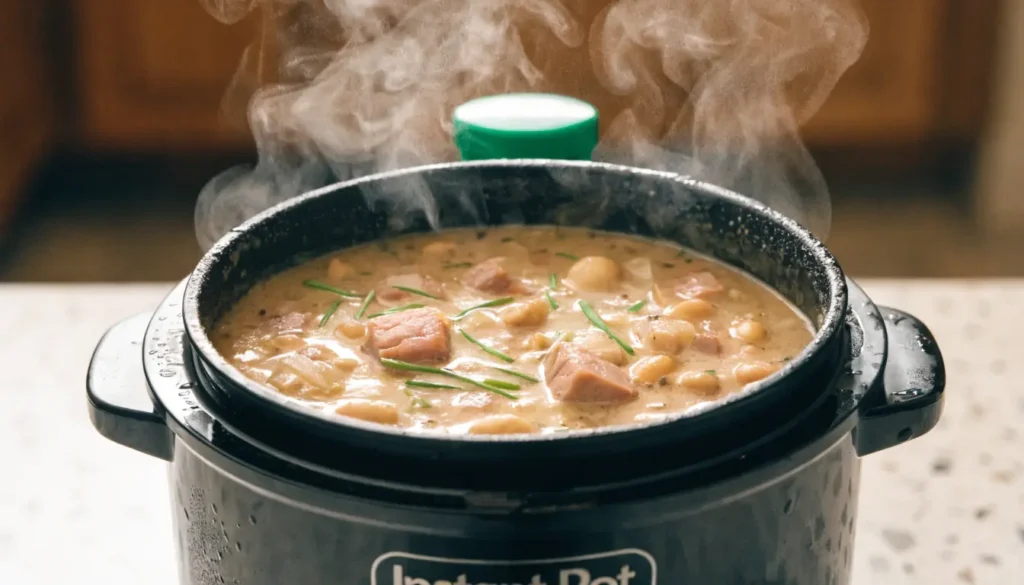
Here is the truth nobody tells you about leftover ham: that ugly, gnawed-on bone is pure gold. Not for soup you have to babysit all afternoon. But for something faster. Something that tastes like it simmered since dawn but actually came together while you folded laundry or answered emails.
You are about to discover why your pressure cooker turns that leftover burden into the best bowl of soup you have made all year. No soaking beans overnight. No standing over a hot stove. Just deep, smoky, creamy comfort that makes you wonder why you ever bothered with the old way.
Let us fix that ham bone problem for good.
Why the Instant Pot is the Secret to Perfect Ham and Bean Soup
You might be skeptical. After all, your grandmother did not use an electric gadget. She used a heavy cast iron pot and most of a Sunday afternoon. And her soup was legendary.
But here is what she knew that most cookbooks leave out: beans are stubborn. They take forever to soften because their skins are designed to resist water. Traditional cooking slowly breaks down those defenses over hours of gentle bubbling.
Your Instant Pot cheats that entire process.
Inside that locked lid, pressure builds to about 15 pounds per square inch. Water boils at 250 degrees Fahrenheit instead of 212. That extra heat penetrates each bean from every angle simultaneously. What used to take six hours now finishes in thirty-five minutes.
Three reasons you will never go back to the stovetop method:
- No pre-soaking required. You read that correctly. Dried beans go straight from the bag into the pot. The pressure does the work of those eight hours of soaking.
- Flavor gets forced inside. Under pressure, hot liquid pushes smoky ham flavor deep into the center of every bean. You get flavor distribution a slow simmer simply cannot match.
- One pot from start to finish. You sauté in the same vessel. You pressure cook in it. You serve from it. Your sink will thank you.
The science is straightforward. Heat plus pressure plus time equals beans that are creamy on the inside but still hold their shape. No blowouts. No mushy mess. Just perfect texture every single time.
Choosing Your Ingredients: The Flavor Trinity
Before you dump everything into the pot and press a button, let us talk about choices. Because the difference between good soup and unforgettable soup happens right here.
The Ham: Bone vs. Hock vs. Leftovers
You have options. Each one changes the final bowl in a different way.
The ham bone is your best friend. Especially if it came from a spiral-sliced holiday ham. That bone is covered in caramelized sugars, smoky bits of meat, and collagen-rich connective tissue. When you pressure cook that thing, the collagen turns into gelatin. That gelatin is what gives expensive restaurant soups that silky, lip-sticking quality.
Smoked ham hocks work beautifully if you do not have a leftover bone. They are cheaper than almost any other cut of pork. Just know they are salt bombs. You will want to adjust your added salt accordingly, probably down to zero.
Diced leftover ham is tricky. If you pressure cook small cubes for thirty-five minutes, they will disintegrate into flavorless shreds. Instead, keep those cubes in the fridge until after the pressure cycle finishes. Stir them in at the very end just to warm through.
The Beans: Dried vs. Canned
Let me save you some disappointment. Canned beans are for salads and quick burritos. They are not for this soup.
| Feature | Dried Beans | Canned Beans |
|---|---|---|
| Final texture | Creamy interior, firm skin | Mushy, falling apart |
| Cost per serving | About fifteen cents | About seventy-five cents |
| Preparation required | Rinse only | Rinse to remove metallic taste |
| Flavor absorption | Excellent | Poor |
You want either Navy beans for the traditional creamy texture, Great Northern beans for the smoothest possible result, or Cannellini beans if you prefer a larger, meatier bean. All three work. Pick whichever your grocery store actually has in stock.
One critical warning: Old beans never soften. If your bag of dried beans has been sitting in your pantry for three years, throw it away. Beans lose their ability to absorb moisture over time. You will pressure cook them for an hour and still end up with pebbles. Buy fresh beans for this recipe.
The Aromatics and Liquid
This is where bland soup becomes unforgettable soup.
You need a standard mirepoix (that is French for flavor base). Two carrots. Two celery stalks. One yellow onion. Dice everything into half-inch pieces so they break down properly during the sauté.
Aromatics that actually matter: Four cloves of fresh garlic (not the jarred stuff), two bay leaves (remove them before serving), one teaspoon of dried thyme, and half a teaspoon of smoked paprika. That smoked paprika is not optional. It bridges the gap between your ham and your beans and makes everything taste like it cooked over a fire.
The liquid breaks every rule you learned from other soup recipes. Do not use water. Water gives you watery soup. Use low-sodium chicken broth instead. Six cups of it. The low-sodium part matters because your ham is already releasing salt into the pot as it cooks.
Step-by-Step: How to Make Instant Pot Ham and Bean Soup
You have your ingredients. Your Instant Pot is sitting on the counter. Let us walk through this exactly so you do not end up with the bean-related disasters I definitely learned the hard way.
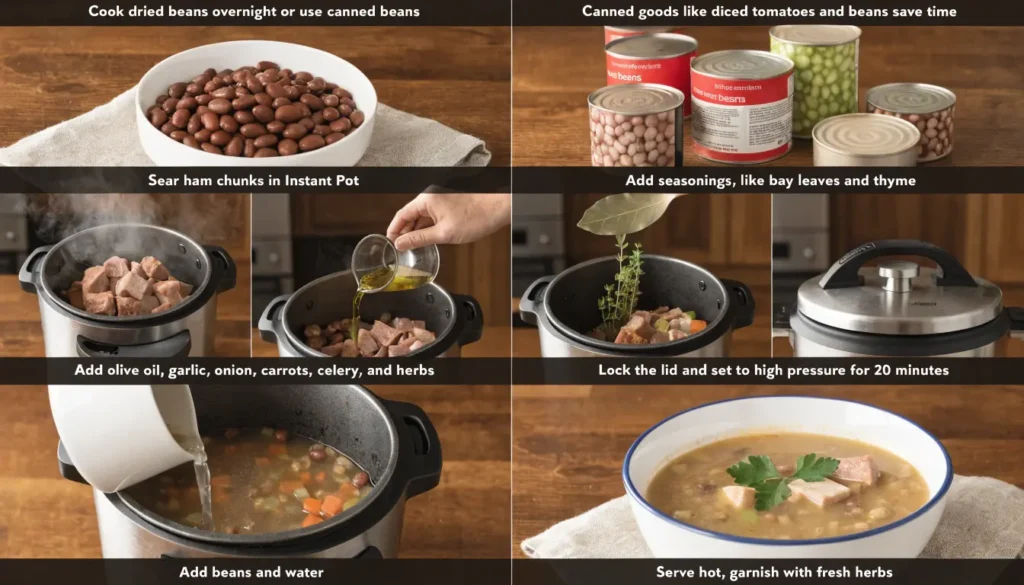
Step 1: Sauté the Foundation
Turn your Instant Pot to the Sauté setting and crank it to High. Give it two minutes to heat up while you measure out one tablespoon of olive oil.
Add your diced onion, carrots, and celery. Stir them around every thirty seconds or so. You are looking for the onions to turn translucent and the carrots to brighten in color. This takes about four minutes.
Here is where most people mess up. They add the garlic at the same time as everything else. Do not do that. Garlic burns in about sixty seconds on high heat. Add it only after the other vegetables have softened, then cook for just one more minute until you smell that amazing roasted garlic aroma.
Add one tablespoon of tomato paste at this same moment. Let it cook for sixty seconds until it darkens to a brick red color. That brief cooking kills the tinny flavor of canned tomato paste and leaves behind a savory depth you cannot get any other way.
Step 2: The No-Soak Magic
Rinse your pound of dried beans under cold running water in a colander. Swish them around with your fingers. Look for any beans that look shriveled or discolored, and pick out any tiny pebbles that sometimes hide in bean bags from the processing plant.
Dump the rinsed beans into the pot on top of your sautéed vegetables. Stir everything together so the beans get coated in that tomato paste mixture.
Crucial rule: Do not add salt yet. Your ham bone is salty. Your chicken broth probably has some salt. You can always add salt at the end. You cannot take it out once it is in.
Second crucial rule: Do not add anything acidic yet. No vinegar. No lemon juice. Acid toughens bean skins and prevents them from softening. Save the bright flavors for after pressure cooking.
Step 3: Pressure Cook to Perfection
Submerge your ham bone into the liquid. Push it down until it is mostly covered. Pour in your six cups of low-sodium chicken broth. The liquid should come up to about the two-thirds mark on the inside of your Instant Pot. Do not overfill. Beans expand.
Lock the lid in place. Turn the steam release handle to the Sealing position.
Select Pressure Cook (or Manual on older models) and set it to High for 35 minutes.
Now you wait.
When the timer beeps, do not touch that steam release. Let the pot sit untouched for 15 minutes of natural pressure release. This is not optional. If you quick-release the pressure immediately, the sudden drop in temperature will cause your beans to explode. You will open the lid to find bean skins floating in starchy water and nothing else.
After fifteen minutes, flip the steam release to Venting to let out any remaining pressure. Wait until the little metal pin drops before trying to open the lid.
Step 4: Finish for Creaminess
Open the lid and breathe in. That smell right there? That is what your grandmother’s kitchen used to smell like.
Carefully remove the ham bone and set it on a cutting board. Let it cool for two minutes, then pick off every bit of meat you can find. Chop that meat into bite-sized pieces and stir it back into the soup.
The thickening trick that changes everything: Get out your immersion blender. Stick it directly into the pot. Pulse it three times. Not five times. Not ten times. Three short pulses. You are not making pureed soup. You are breaking up about twenty percent of the beans to release their natural starch, which thickens the broth without adding flour or cream.
Stir in one tablespoon of apple cider vinegar at this point. That tiny bit of acid cuts through the richness and wakes up every other flavor in the bowl.
Taste your soup. Now you can add salt if it needs it. Probably it does not. Add black pepper aggressively. Beans love black pepper.
Pro Variations: 4 Ways to Change the Flavor Profile
Maybe you have made this soup ten times already and want something different. Try one of these.
Spicy Southern: Add one diced jalapeño (seeds included if you want heat) and one teaspoon of cayenne pepper during the sauté stage. Serve with cornbread.
Creamy Tuscan: After pressure cooking, stir in half a cup of heavy cream and a quarter cup of finely grated parmesan cheese. The cream balances the smokiness of the ham beautifully.
Greens and Grains: Add two cups of chopped kale and half a cup of pearled barley before pressure cooking. Increase your chicken broth to seven cups to account for the barley absorbing liquid. The kale wilts down to nothing but adds a pleasant chew.
Vegetarian Version: Skip the ham entirely. Use two tablespoons of liquid smoke and one cup of sliced shiitake mushrooms instead. Liquid smoke is controversial, but one bottle lasts for years and adds genuine fire-roasted flavor to vegetarian dishes.
Troubleshooting: Why Your Soup Went Wrong
Even experienced cooks hit problems sometimes. Here is how to fix the most common disasters.
“My beans are still hard after thirty-five minutes.”
Your beans are old. That is almost always the answer. Dried beans sit in grocery store warehouses for months or years. If you cannot remember buying them, buy a fresh bag. To salvage this batch, add half a teaspoon of baking soda and pressure cook for another ten minutes. The baking soda raises the pH of the water, which helps soften stubborn skins.
“My soup is watery and thin.”
You did not pulse with the immersion blender. Or you used canned beans. Or both. Fix watery soup by removing one cup of beans, mashing them against the side of a bowl with a fork, and stirring the paste back in. That mashed bean paste thickens instantly without changing the flavor.
“It is so salty I cannot eat it.”
This happens when you use a salty ham bone AND regular chicken broth instead of low-sodium. The fix is weird but effective: peel one raw potato, drop the whole potato into the hot soup, and let it sit for fifteen minutes. The potato absorbs excess salt like a sponge. Remove and discard the potato before serving.
Storage, Freezing and Meal Prep
This soup gets better on day two. Something magical happens overnight as the flavors continue to meld. Make it on a Sunday and eat it through Thursday.
In the refrigerator: Five days in an airtight container. Let it cool completely before putting the lid on, or condensation will water down your carefully thickened broth.
In the freezer: Three months. Cool the soup completely, then portion it into freezer-safe containers. Leave an inch of headspace because liquid expands when frozen. Souper cubes (those silicone trays that make one-cup frozen blocks) are perfect for this soup.
Reheating: Thaw frozen soup overnight in the refrigerator. Reheat on the stovetop over medium-low heat, stirring occasionally. Add a splash of chicken broth if the soup thickened too much during storage.
Frequently Asked Questions
Do I really need to soak beans for Instant Pot ham and bean soup?
No. That is the entire point of using a pressure cooker. The high pressure and temperature eliminate the need for soaking. Just rinse your dried beans, pick through them for stones, and add them directly to the pot.
Can I use a leftover Christmas ham bone for Instant Pot ham and bean soup?
Absolutely. That is the ideal scenario. The leftover bone from a spiral ham still has caramelized glaze on it. That glaze adds sweetness and complexity you cannot replicate with plain smoked pork.
Why did my Instant Pot ham and bean soup turn purple or blue?
You added garlic too early and it reacted with an acidic ingredient like tomatoes or vinegar. The discoloration looks alarming but is completely safe to eat. To prevent it in the future, add your garlic after you finish sautéing the vegetables, not before.
How do I thicken Instant Pot ham and bean soup without a blender?
Mash one cup of the cooked beans against the side of the pot with a fork. Stir the mashed beans back into the soup. The released starch thickens the broth almost immediately.
Can I double this recipe in a six-quart Instant Pot?
Yes, but do not exceed the half-full line. Beans expand to three times their dried volume during cooking. Two pounds of dried beans is the safe maximum for a six-quart pot. Anything more than that risks clogging the steam valve.
Your New Cold-Weather Ritual
You just turned a leftover ham bone and five dollars worth of dried beans into twelve servings of deep, soulful soup. That is not cooking. That is alchemy.
The best part is what you did not do. You did not stand over a stove for six hours. You did not remember to soak beans the night before. You did not spend twenty dollars on specialty ingredients. You used what you had, pressed a button, and walked away.
Keep that ham bone from your next holiday dinner. Wrap it in foil. Stick it in a freezer bag. Write the date on the bag with a marker. And the next time a cold rain is hitting your windows and you need something warm, you will be exactly thirty-five minutes away from a bowl of healing.
Here is what I want you to do right now: Go dig that leftover ham bone out of your freezer. Leave a comment below telling me what you are adding to your soup that makes it uniquely yours. Maybe it is a splash of bourbon. Maybe it is a handful of collard greens. Maybe it is a spoonful of spicy brown mustard stirred in at the table.
Share your twist. I read every single comment.
And when you make this soup tonight, serve it with the crustiest bread you can find and a sprinkle of fresh parsley just because you deserve something pretty on top.