You’re sitting at a sleek sushi bar, the hum of conversation buzzing around you, when the server places that small black lacquered bowl in front of you. Steam rises in delicate swirls, carrying that unmistakable aroma—earthy, salty, deeply comforting. Your mouth waters instinctively. But then it happens. That pause. That split second where your brain shifts from anticipation to assessment.
Can I eat this?
If you’re navigating a gluten-free life—whether because of celiac disease, a confirmed sensitivity, or a personal choice to eliminate wheat—you know this moment intimately. It’s the same hesitation you feel at cocktail parties staring down platters of anonymous finger foods, or when a well-meaning relative brings over a “surprise” dessert. That beautiful bowl of miso soup, so simple and innocent-looking, suddenly becomes a question mark.
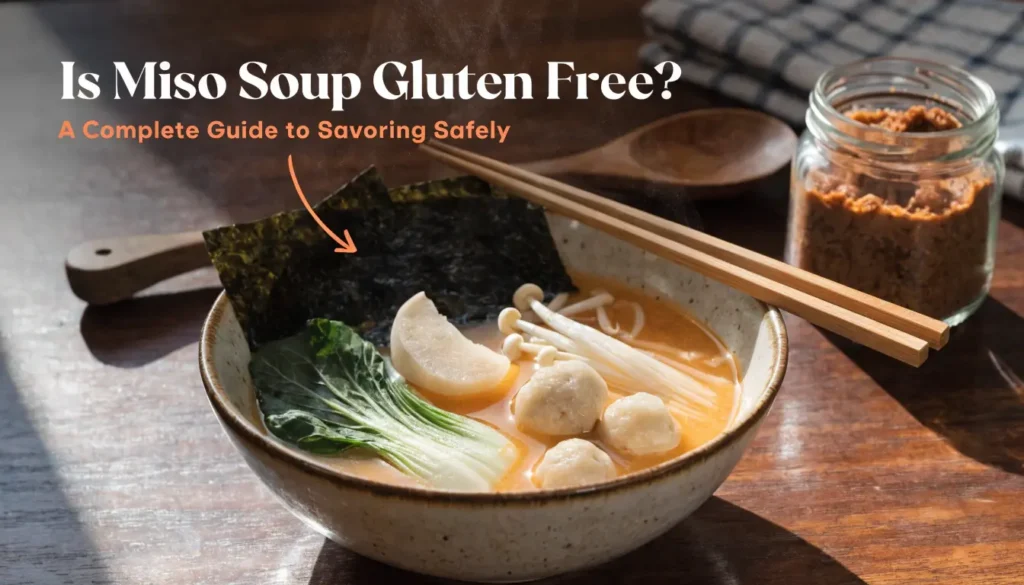
Maybe you’ve been burned before. Perhaps you trusted the wrong bowl and spent the next day regretting it. Or maybe you’re newly diagnosed and still learning which foods harbor hidden gluten. Either way, you’re here because you want clarity. You want to walk into any restaurant, any friend’s kitchen, any grocery store, and know exactly what to look for.
The truth about miso soup and gluten isn’t as simple as a yes-or-no answer. But by the time you finish reading this, you’ll have a roadmap so clear that you’ll never have to hesitate again. You’ll know which ingredients to trust, which questions to ask, and how to recreate this comforting classic safely in your own kitchen.
Let’s dig in—literally.
What Exactly Are We Dealing With Here?
Before you can determine whether miso soup fits into your gluten-free life, you need to understand what actually goes into that bowl. Miso soup appears deceptively simple, but its composition tells a more complex story.
Every bowl of authentic miso soup rests on two fundamental pillars:
- Miso paste – the fermented soybean base that gives the soup its signature savory punch
- Dashi – the Japanese soup stock that forms the liquid foundation
Here’s where things get interesting. Both of these components can be completely gluten free. Both of them are also frequently made with gluten-containing ingredients. Your safety depends entirely on understanding where gluten hides in each element.
Think of it like building a house. You need a solid foundation and quality materials. If either one is compromised, the whole structure becomes unsafe. The same logic applies here. You need both your miso and your dashi to be gluten free for the final soup to be safe.
The Miso Mystery: Breaking Down the Paste
Let’s start with the star of the show—the miso itself. This ancient fermented paste has been a cornerstone of Japanese cuisine for centuries, and understanding its production is your first step toward eating safely.
Miso begins its life as soybeans. Cooked soybeans are combined with salt and a specific type of mold called koji (Aspergillus oryzae). This mixture then ferments for anywhere from a few weeks to several years, developing the complex flavors that miso is known for.
But here’s the crucial detail that determines gluten safety: the koji mold needs to grow on something. In traditional miso production, that “something” is a grain. And the type of grain used makes all the difference.
The Three Main Miso Families
Rice Miso (Kome Miso)
This variety uses rice as the base for growing koji. When you see rice miso made with 100 percent rice, no barley, no wheat, no rye—you’re looking at a naturally gluten-free product. Rice miso tends to be milder and sweeter than other varieties. It’s what many Japanese households use for everyday cooking, and it’s your safest bet when shopping for miso.
Soybean Miso (Mame Miso)
True to its name, this miso uses only soybeans to cultivate the koji. No grains whatsoever. This is the most traditional form of miso, and it’s automatically gluten free. However, it’s also the least common variety in Western markets. Soybean miso has a deep, dark color and an intensely savory flavor that develops over long fermentation periods—sometimes up to three years.
Barley Miso (Mugi Miso)
Here’s where you need to pay close attention. Barley miso uses barley as the grain for koji cultivation. Barley contains gluten. If you have celiac disease or any form of gluten sensitivity, barley miso is off the table completely.
The challenge? Barley miso is enormously popular throughout Japan. In many traditional households and restaurants, especially those priding themselves on authentic preparation, barley miso is the default choice. Its robust, earthy flavor profile makes it a favorite among miso enthusiasts. But that authentic flavor comes at a cost for gluten-free diners.
The Color Confusion
You might have heard people refer to white miso, yellow miso, or red miso and assume these categories indicate gluten content. Let’s clear that up right now.
Miso color corresponds to fermentation time, not ingredients:
- White miso (shiro) ferments briefly, often just weeks, and typically uses rice koji
- Yellow miso (shinshu) ferments longer and may use rice or barley
- Red miso (aka) ferments for months or years and could be made with either grain
The color tells you about flavor intensity—white is mild, red is robust—but it doesn’t guarantee gluten freedom. You absolutely cannot look at a bowl of miso soup, notice its pale color, and assume it’s safe. The only reliable indicator is knowing exactly what went into that paste.
The Broth Factor: Why Dashi Deserves Your Attention
You’ve confirmed your miso paste is gluten free. Good for you. But don’t celebrate yet, because the liquid surrounding that paste presents its own set of challenges.

Traditional dashi, the foundation of Japanese soups and cooking, is actually quite simple. Purists make it with just two ingredients:
- Kombu – dried kelp that contributes umami and minerals
- Katsuobushi – dried, fermented, and smoked skipjack tuna shaved into paper-thin flakes
When you simmer kombu gently (never boiling, which makes it bitter), then add bonito flakes and let them steep, you get a crystal-clear broth that’s naturally, reliably gluten free.
That’s the ideal scenario.
The Convenience Trap
Here’s what happens in most restaurants, and many home kitchens too. Time is precious. Making dashi from scratch takes patience and planning. So cooks reach for shortcuts:
- Dashi powder – granules that dissolve instantly in hot water
- Hon-dashi – concentrated instant dashi products
- Dashi packets – tea-bag-style infusions
And this is where gluten sneaks back in.
Manufacturers of instant dashi products frequently add hydrolyzed wheat protein as a flavor enhancer. It boosts that savory quality you’re looking for. Some products include maltodextrin derived from wheat. Others incorporate soy sauce—which nearly always contains wheat—to round out the flavor profile.
You might order miso soup at a restaurant, ask about the miso paste, get confirmation it’s rice miso, and feel completely safe. But if that soup was made with dashi powder containing wheat derivatives, you’re consuming gluten anyway. The miso was safe, but the broth betrayed you.
This is why asking only about miso paste isn’t enough. You have to trace the entire soup back to its origins.
What About Toppings?
Even with safe miso and safe dashi, your soup could still harbor gluten in its garnishes. Let’s look at the usual suspects:
Tofu – Plain tofu consists of soybeans, water, and a coagulant like nigari or calcium sulfate. That’s it. Plain tofu is gluten free. However, some restaurants use aburaage, which are thin slices of tofu that have been deep-fried. These sometimes get simmered in a mixture that includes soy sauce before being added to soups. Ask about preparation.
Wakame seaweed – Dried wakame is simply seaweed. It’s naturally gluten free. But watch out for seasoned seaweed mixes that might include soy sauce or mysterious “flavorings.”
Kamaboko (fish cake) – Those pink-and-white slices you sometimes see floating in miso soup are processed seafood products. Some brands use wheat starch as a binder. Unless you can verify the ingredients, this topping carries risk.
Green onions – Totally safe. No gluten here. Add freely.
Noodles – If your miso soup arrives with noodles floating in it, and those noodles are udon or ramen, you’re looking at wheat-based products. Some soba noodles are 100 percent buckwheat and gluten free, but many contain wheat flour. Never assume.
Your Action Plan for Safe Miso Soup
Enough with the warnings. You need practical strategies, and you need them now. Here’s exactly how to protect yourself in any situation.
When You’re Cooking at Home
Shopping for Miso Paste
Pull out your reading glasses and settle in for some label scrutiny. You’re looking for:
- A certified “Gluten-Free” seal from a reputable organization
- Ingredients listed as only: soybeans, rice, salt, water
- Absence of any mention of barley, wheat, rye, or malt
Some reliable brands to start with:
Hikari Organic Miso offers several varieties clearly labeled for gluten content. Their organic rice miso is typically safe, but always verify the specific product.
Miso Master Organic Miso makes this easy by printing “Gluten-Free” right on the front of their rice miso containers. They’re widely available in natural food stores.
South River Miso operates a dedicated gluten-free facility and produces several award-winning varieties. Their products cost more but deliver exceptional quality and complete safety.
Making Your Own Dashi
You have options here, and none of them require advanced culinary skills.
Traditional kombu and bonito method: Soak a 4-inch piece of kombu in 4 cups of water for 30 minutes. Heat gently over medium flame. Right before the water reaches a boil, remove the kombu. Add a handful of bonito flakes, turn off the heat, and let them steep for 5 minutes. Strain. That’s it. You’ve made authentic, gluten-free dashi.
Quick vegetarian method: Skip the bonito and just use kombu. You’ll get a milder broth, but it’s still delicious and perfectly safe. Some people add a small piece of dried shiitake mushroom during steeping for extra depth.
Store-bought shortcut: Look for dashi packets or powders explicitly labeled gluten free. Several Japanese brands now offer gluten-free instant dashi for the convenience-minded cook. Just read those labels carefully.
Building Your Bowl
Once you have safe miso and safe dashi, assembly is straightforward:
- Warm your dashi gently in a pot
- In a separate small bowl, dissolve miso paste in a ladleful of warm dashi, whisking until smooth
- Return this mixture to the main pot
- Add cubed tofu and rehydrated wakame
- Heat through but never boil (boiling kills beneficial bacteria and can alter flavor)
- Serve immediately with chopped green onions
When You’re Eating Out
Restaurant dining requires a different approach. You’re at the mercy of kitchen practices and staff knowledge. But you can stack the odds in your favor.
Questions Worth Asking
Don’t feel awkward about this. Your health matters more than anyone’s fleeting discomfort. Ask clearly and kindly:
“Do you know what kind of miso paste you use? Is it rice miso or barley miso?”
Some servers will know immediately. Others will need to check with the kitchen. That’s fine. Wait for a definitive answer.
“How do you make your dashi? From scratch, or do you use powder?”
If they use powder, ask to see the package. If they can’t produce it, assume the soup contains gluten. If they make dashi from scratch, ask whether they add any soy sauce or other seasonings.
“Does your kitchen add anything else to the miso soup before serving?”
Some restaurants finish their soup with a splash of soy sauce or a sprinkle of mysterious “seasoning.” You need to know.
Interpreting Responses
Listen carefully to how your questions get answered. Some responses inspire confidence:
- “Let me check the package for you and read the ingredients.”
- “Our head chef can tell you exactly what’s in it.”
- “We have a separate gluten-free menu with ingredient information.”
Other responses should raise red flags:
- “I think it’s probably fine.” (Thinking isn’t knowing.)
- “It’s just regular miso soup.” (Regular doesn’t mean safe.)
- “We’ve never had anyone complain.” (Complaints aren’t medical evidence.)
If you get vague answers or a server who seems annoyed by your questions, trust your gut. Skip the soup. Order something you’re certain about.
The Science Behind Safety
You might wonder whether fermentation affects gluten proteins. It’s a fair question. If barley miso ferments for months, doesn’t that break down the gluten?
Research says no, not enough to matter.
A 2006 study published in the Journal of Agricultural and Food Chemistry examined what happens to gluten during fermentation. The researchers found that while some protein breakdown occurs, significant immunoreactive fragments remain intact. Your immune system can still detect and react to these fragments.
Fermentation isn’t digestion. It doesn’t reduce gluten to safe levels for people with celiac disease. If you’re among the estimated 1 percent of the population with this autoimmune condition, you cannot rely on fermentation to save you. The same applies if you have non-celiac gluten sensitivity and experience symptoms after exposure.
Barley miso contains gluten. Fermented or not, it will make you sick. Full stop.
What You Actually Get From Safe Miso Soup
Assuming you’ve navigated all the potential pitfalls and secured yourself a truly gluten-free bowl, what are you actually consuming? Quite a lot, as it turns out.
A standard cup of miso soup contains roughly:
- 35 to 50 calories
- 2 to 3 grams of protein
- 1 to 2 grams of fat
- 4 to 6 grams of carbohydrates
- 600 to 900 milligrams of sodium (varies significantly by preparation)
That sodium number deserves attention. If you’re watching your salt intake, factor miso soup into your daily totals. The trade-off comes in other nutritional benefits.
Gut Health Support
Live fermented foods contain beneficial bacteria that may support digestive health. However—and this matters—if you boil your miso soup after adding the paste, you’ll kill those bacteria. For maximum probiotic benefit, warm your soup gently and add miso at the very end, off the heat.
Mineral Content
Depending on your dashi ingredients and miso variety, you’ll get varying amounts of:
- Manganese
- Copper
- Zinc
- Phosphorus
- Various B vitamins from the fermentation process
Hydration Factor
Warm liquids digest more easily than cold ones for many people. The sodium in miso soup can help with electrolyte balance, especially if you’re active or live in a hot climate. Just balance it with plenty of water throughout your day.
Your Questions, Answered
Can I eat miso soup at any Japanese restaurant if I ask nicely?
You can ask, and you should. But asking doesn’t guarantee a positive outcome. Some restaurants simply don’t have gluten-free options. Others will accommodate you beautifully. The key is being prepared to hear “no” gracefully and having backup options in mind.
What about those instant miso soup packets in the grocery store?
Most contain barley miso or wheat-based additives. However, several brands now offer certified gluten-free instant miso soup. Look for them in natural food stores or the specialty diet section of larger supermarkets. Always check the label, even on products you’ve bought before—formulations change.
Is white miso always safer than red miso?
No. While white miso commonly uses rice koji, you can’t assume this. Some white miso products contain barley. Some red miso products use only soybeans. Color indicates fermentation time, not ingredients. Read labels, don’t rely on color cues.
If I’m traveling in Japan, how do I manage this?
Carry a gluten-free restaurant card written in Japanese. These cards explain your condition and list forbidden ingredients clearly. Many celiac advocacy organizations provide free downloadable versions. In tourist-heavy areas, some restaurants now cater specifically to gluten-free visitors, but in smaller towns and traditional establishments, you’ll need that card.
Can children with celiac disease eat miso soup prepared with care?
Yes, with the same precautions you’d take for yourself. Use certified gluten-free miso and dashi. Avoid questionable toppings. Introduce it slowly to ensure tolerance. Many children enjoy the mild, savory flavor.
Moving Forward With Confidence
Remember that hesitation we talked about at the beginning? The moment of uncertainty when that beautiful bowl arrives? You don’t have to live there anymore.
You now know that miso soup can be gluten free. You know exactly where gluten hides—in barley miso, in instant dashi products, in processed toppings. You know what questions to ask and which answers to trust. You know how to build a safe bowl in your own kitchen and how to advocate for yourself in restaurants.
This knowledge transforms your relationship with food. It replaces anxiety with empowerment. It turns that moment of hesitation into a moment of informed decision-making.
The next time you’re sitting at that sushi bar, watching steam rise from a small black bowl, you’ll know what to do. You’ll ask your questions calmly and clearly. You’ll evaluate the answers with confidence. And if the soup isn’t safe, you’ll decline without guilt or embarrassment. If it is safe, you’ll lift that bowl to your lips and savor every drop—fully present, fully protected, fully enjoying the moment.
That’s what gluten-free living should feel like. Not restriction and fear, but knowledge and freedom. You deserve to eat well, to connect with others over food, to experience the rich traditions of global cuisine without compromising your health.
Now go enjoy some soup. You’ve earned it.
Have you found a favorite gluten-free miso brand or a restaurant that handles your needs exceptionally well? Share your recommendations below—your experience might be exactly what another reader needs to find their own safe bowl.