You know that wobbly, almost-empty feeling right after you finish a tough session? The one where your legs feel like wet cement and your brain just wants a nap? I used to think that meant I’d worked hard enough. Good sign, right? Wrong.
For about two years, I stumbled through my afternoons post-workout. I’d grab a protein bar that tasted like cardboard or, worse, skip eating entirely because I was “going to cook dinner soon.”
My muscles stayed sore for what felt like forever. My progress on the squat rack? Stalled. Then a trainer friend finally shook me by the shoulders and said, “You’re training like an athlete and recovering like a couch potato.”
That hit home. So I started experimenting. What I landed on was a simple, repeatable post workout smoothie recipe that changed how I feel by 8 AM. No chalky powders. No ten-ingredient lists. Just real food that works fast. You’re about to get the exact blueprint—mistakes included—so you don’t waste another sore, grumpy afternoon.
Why Your Body Gets Grumpy Without a Proper Post Workout Drink
Let’s talk about what’s actually happening inside your muscle fibers right after that last rep or final sprint. When you push hard, you’re creating microscopic tears in your muscle tissue. That’s not bad—that’s how you grow. But those tears come with two problems.
First, your glycogen tanks are empty. Think of glycogen as the gas left in your car after a long trip. If you don’t refill, your next workout starts on fumes. Second, your muscle cells become extra thirsty for amino acids to start repairing those tears. Miss that window, and your body starts breaking down other stuff—including more muscle—to find what it needs.
Here’s what happens when you skip recovery nutrition:
- Your soreness sticks around for two or three extra days
- That heavy, foggy feeling in your legs doesn’t fade
- You get weird cravings for salty or sugary junk food
- Your next workout feels twice as hard as it should
The Journal of the International Society of Sports Nutrition published data showing that protein intake within thirty minutes of training boosts muscle protein synthesis by nearly 50 percent compared to waiting two hours. Fifty percent. That’s not tiny. That’s the difference between looking the same in three months versus actually seeing new definition.
So no, you’re not being high-maintenance by making a smoothie. You’re being smart.
The Four Pillars That Turn a Smoothie Into a Recovery Tool
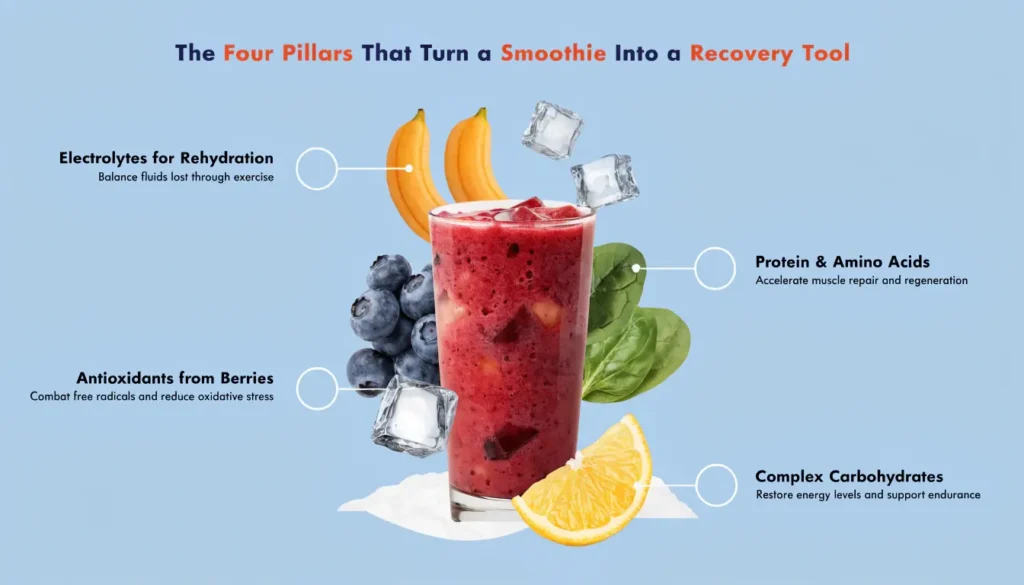
Not every smoothie deserves the title “post workout.” Throw some random fruit and milk in a blender, and you’ve got a tasty drink, sure. But a real recovery shake follows specific rules. Let me walk you through the four pieces you need every single time.
Pillar One – Quick Protein for Torn Fibers
Your muscles don’t want to wait around for a steak to digest. They want fast-absorbing protein that hits the bloodstream within twenty minutes. Whey isolate is the gold standard here because it’s low in lactose and zips through your gut. If you avoid dairy, pea protein works almost as quickly. Greek yogurt is another solid choice, though it’s a bit slower.
How much? Aim for twenty to forty grams, depending on your size. If you weigh under 150 pounds, stick closer to twenty. Over 180 pounds? Lean toward thirty-five or forty.
Pillar Two – Carbs That Actually Help
Here’s where most people mess up. They think protein alone does the job. But without carbohydrates, that protein can’t get efficiently shuttled into your muscle cells. Carbs spike insulin just enough to open the doors. Plus, they refill your drained energy stores.
You want a mix of simple and complex carbs. A banana gives you quick sugar for immediate energy. Rolled oats provide slower-burning fuel for the next few hours. For endurance athletes—runners, cyclists, swimmers—go with a three-to-one carb-to-protein ratio. For strength training, one-to-one works beautifully.
Pillar Three – Healthy Fats (But Not Too Many)
This one confuses people. Fats are good for you. They fight inflammation and support hormone production. But here’s the catch: fat slows down digestion. If you load your post workout smoothie with a whole avocado, two tablespoons of peanut butter, and coconut oil, you’ve just turned a fast-acting recovery drink into a slow-moving meal.
Save the heavy fats for your breakfast or lunch. For right after training, stick to one small source—maybe a tablespoon of flaxseed or a quarter of an avocado. That’s plenty.
Pillar Four – Liquids That Put Back What You Sweated Out
You lost more than water in that workout. Electrolytes like sodium, potassium, and magnesium went with it. Reach for unsweetened coconut water instead of plain water or juice. Coconut water naturally packs potassium and a little sodium. Almond milk works too, but you’ll need to add a pinch of sea salt separately.
Avoid fruit juice as a base. A sixteen-ounce orange juice contains over fifty grams of sugar—that’s soda territory. That much sugar spikes your insulin so high that it actually blunts growth hormone release. Not what you want after all that effort.
Three Post Workout Smoothie Recipes Built for Different Goals
Now let’s get practical. You came here for a post workout smoothie recipe you can actually use. Here are three, each designed for a different outcome.
Recipe One – The Muscle Builder (For Strength and Size)
This one is for you if you lift heavy things and want to see your shoulders and quads grow.
Ingredients:
- One scoop of chocolate whey isolate
- One frozen banana (peel it before freezing, trust me)
- One tablespoon of almond butter
- One cup of unsweetened oat milk
- A quarter cup of rolled oats
What you’re getting: Forty-five grams of protein, fifty-five grams of carbs, eighteen grams of fat. Drink this within twenty minutes of your last deadlift or bench press set.
The texture tip: Add the oats dry. Don’t cook them. They blend into a fine powder that thickens the smoothie like a milkshake.
Recipe Two – The Endurance Refuel (For Runners and Cyclists)
You logged ten miles or two hours on the bike. Your legs are toast, and you’re dripping sweat. This recipe puts back what you lost.
Ingredients:
- Half a cup of cottage cheese (slow-release casein protein)
- One cup of frozen mango
- One and a half cups of coconut water
- One tablespoon of honey
- A generous pinch of sea salt
What you’re getting: Twenty-eight grams of protein, seventy-five grams of carbs, five grams of fat. That salt isn’t optional—it replaces the sodium you sweated out. Without it, you’ll feel shaky for hours.
Recipe Three – The Lean Out (For Fat Loss Focus)
You want to preserve muscle while dropping body fat. Skip the banana and oats here.
Ingredients:
- One scoop of unflavored plant protein
- One cup of fresh spinach (you won’t taste it, promise)
- Half a cup of frozen blueberries
- One cup of unsweetened almond milk
- Half a teaspoon of fresh ginger
What you’re getting: Twenty-five grams of protein, twenty grams of carbs, four grams of fat. The blueberries fight oxidative stress from training, and the ginger knocks down inflammation without adding calories.
Five Mistakes You’re Probably Making With Your Post Workout Shake
I made every single one of these. Learn faster than I did.
One – Adding too much fat. A full scoop of peanut butter, two tablespoons of chia seeds, and half an avocado makes a delicious smoothie. It also sits in your stomach for two hours. Stick to one fat source under ten grams total.
Two – Skipping carbs entirely. I see people blend protein powder with water and call it a day. Without carbs, your body pulls amino acids from your bloodstream and converts them into glucose. That defeats the whole purpose. Add half a banana or a quarter cup of berries.
Three – Using juice as your liquid base. Juice is sugar water with a health halo. A post workout smoothie recipe should not read like a dessert menu. Stick to coconut water or unsweetened milk.
Four – Blending for three minutes. High-speed blending generates heat. Heat destroys vitamin C and some B vitamins. Forty-five seconds is plenty. Anything longer, and you’re making warm fruit soup.
Five – Waiting too long to drink it. Your muscle cells are most insulin-sensitive for about sixty minutes after training. After that, their ability to grab nutrients drops by nearly half. Blend it, pour it, drink it. Don’t save it for later.
How to Adjust Your Smoothie for Different Diets
Maybe you don’t do dairy. Maybe you’re watching every carb. That’s fine. Here’s how to swap ingredients without wrecking the recovery benefits.
For vegan or plant-based eaters: Swap whey for pea or soy protein. Add one tablespoon of chia seeds to replace the omega-3s you’d get from fish or eggs.
For keto or low-carb dieters: Use unsweetened macadamia milk. Skip the banana entirely. Use blackberries instead of blueberries (fewer carbs). Add a tablespoon of MCT oil for quick energy without sugar.
For paleo or dairy-free folks: Collagen peptides work if your body tolerates them. Egg white protein is another option. Sweeten with one medjool date instead of honey.
For nut-free kitchens: Replace almond butter with pumpkin seed butter. Swap almond milk for oat milk. Check your protein powder label—many are processed on equipment shared with tree nuts.
Your Step-by-Step Blending Routine
You want this to become automatic. Here’s how to make it happen without thinking.
The night before: Peel two or three bananas. Break them in half and freeze them in a bag. Portion your frozen fruit into single-serving bags. Morning you will thank you.
Right after your workout (zero to ten minutes): Drink sixteen ounces of plain water first. Your body is dehydrated. Don’t make your smoothie do double duty as both hydration and recovery.
Ten to fifteen minutes post-workout: Add your liquids to the blender first. This stops powder from caking on the bottom. Then add powders, then fresh ingredients, then frozen stuff last.
Fifteen to sixty minutes post-workout: Pour and sip slowly over five to ten minutes. Chugging can cause bloating because your stomach isn’t ready for that much cold liquid at once.
Immediately after pouring: Rinse the blender with cold water. If you let residue dry, you’ll be scrubbing for five minutes later.
One more thing: a cheap blender will leave gritty chunks of protein powder. If you make smoothies more than twice a week, invest in a Nutribullet or a secondhand Vitamix. Your texture—and your enjoyment—will improve overnight.
Frequently Asked Questions
Can I drink a post workout smoothie if I’m trying to lose weight?
Yes. Use the Lean Out recipe above. Skip nut butters and honey. Keep it under two hundred fifty calories total. And drink it in place of a meal, not on top of one. If you have it plus a full breakfast, you’re adding calories, not swapping them.
What’s the best post workout smoothie recipe for morning workouts?
The Muscle Builder recipe works great, but swap the banana for half a cup of pumpkin puree. Pumpkin gives you slower-digesting carbs that fuel your morning without a sugar crash. Add a tiny pinch of cayenne pepper—it warms you up and gives your metabolism a little nudge.
Is it safe to have one every single day?
Absolutely. But rotate your ingredients. Use whey three days a week, pea protein two days, and egg white protein the other two. Rotate your fruits too. Eating the exact same thing daily can lead to minor food sensitivities over time. Keep your body guessing.
Can I make my post workout smoothie ahead of time?
You can, but drink it within twenty-four hours. Store it in a mason jar filled all the way to the top—less air means less oxidation. Shake hard before drinking. Never freeze an already-blended smoothie unless you enjoy a grainy, separated mess.
What if I don’t own a blender?
Make a shaker-bottle version. Mix protein powder, powdered peanut butter, and oat flour (just raw oats ground into dust). Add water or coconut milk. Shake for thirty seconds. The texture isn’t as nice, but the nutrition is nearly identical.
Your Next Step Starts Tomorrow Morning
You don’t need a cabinet full of supplements. You don’t need a nutrition degree. You just need one post workout smoothie recipe that fits your body and your goals. Pick the recipe that matches what you do most often. If you lift, go with the Muscle Builder. If you run, take the Endurance Refuel. If you’re leaning out, stick with the Lean Out.
Tonight, write down three ingredients you need to buy. Tomorrow after your workout, blend within fifteen minutes. Do that for seven days straight. Then notice how you feel. Less soreness. More energy in the afternoon. A craving for your next workout instead of a nap.
Your muscles are sending you a signal every time you finish training. They’re not asking for much. Just a little fuel, delivered fast. Give them what they deserve.
Now it’s your turn: Try Recipe One tomorrow morning. Then come back to the article and drop a comment. Which fruit combo surprised you? Did you try the salt trick in the endurance recipe? I read every reply, and your wins keep me writing. Let’s hear it.