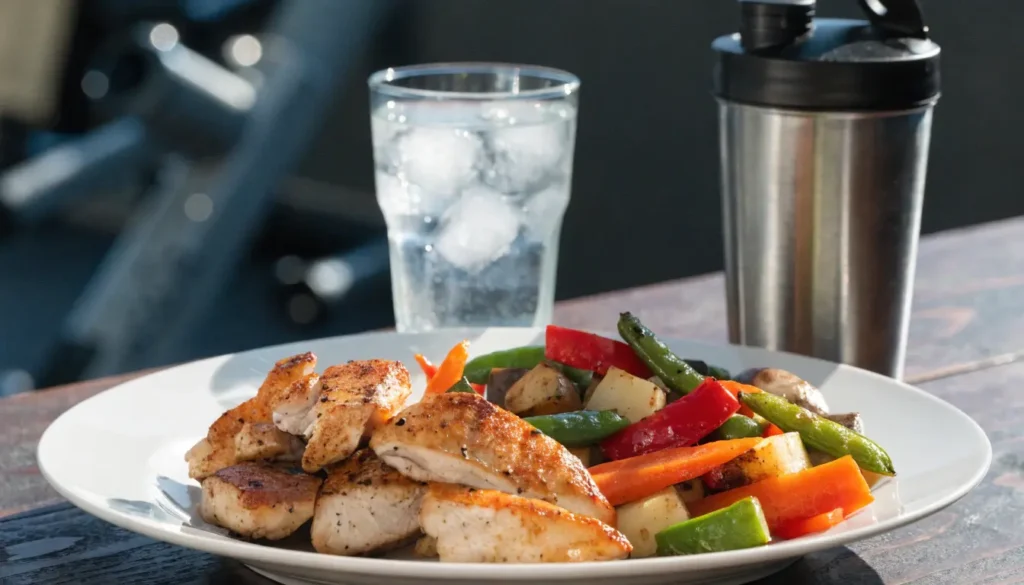
You know that moment when you peel yourself off the gym floor after a savage leg session, and your quads are screaming so loud you can barely hear the thumping music overhead? Yeah, that moment. The one where you feel like you’ve genuinely left every ounce of effort on that rubber flooring. For the longest time, I thought that feeling—that complete and utter exhaustion—was the signal that I’d done enough. I’d grab my gym bag, chug some water, and head home thinking the hard part was over.
Man, was I wrong.
The hard part wasn’t over. It was just getting started. And I didn’t realize it until months had slipped by with barely any change in the mirror. The scale wouldn’t budge. The weights weren’t getting any easier. I was stuck in neutral, grinding away without actually moving forward. Sound familiar?
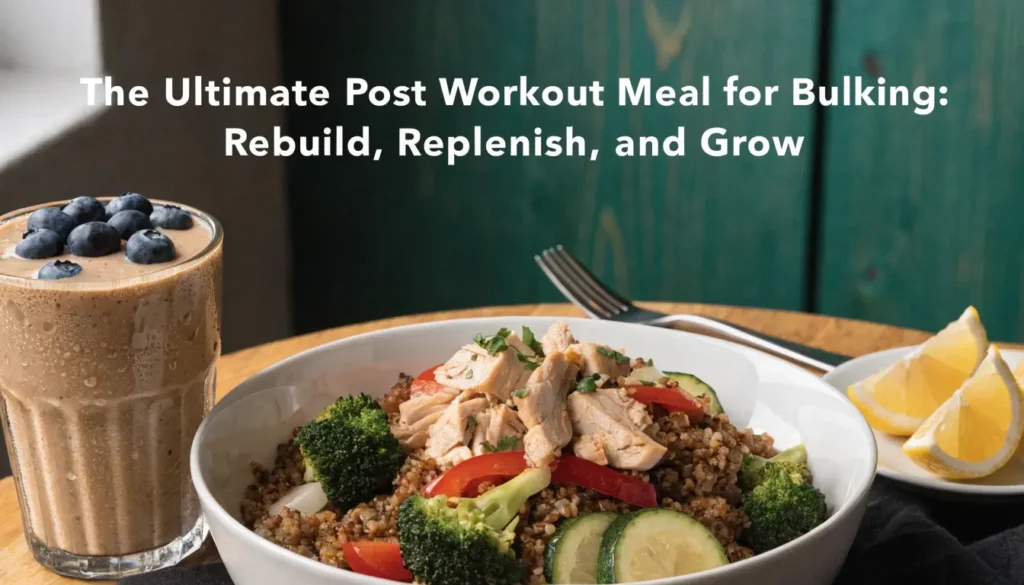
Here’s what took me embarrassingly long to figure out: that post-workout window isn’t just some optional courtesy you extend to your muscles. It’s the entire point. Everything you just did—every rep, every drop of sweat, every moment of wanting to quit but pushing through—it all hangs on what happens next. The meal you eat after training doesn’t just refuel you. It determines whether your effort turns into growth or just fades away like yesterday’s pump.
Let’s fix that. Together.
Why Your Post-Workout Meal is the Most Important Part of Bulking
Think about what you just put your body through. You walked into that gym and deliberately tore muscle fibers apart. You drained your energy reserves down to fumes. You stressed your nervous system, flooded your bloodstream with cortisol, and basically told your body, “Hey, we’re in survival mode now.”
That’s not weakness. That’s the whole point of training. But here’s what separates people who build noticeable muscle from those who just stay “gym regulars”: understanding that growth doesn’t happen during the workout. It happens after, when you’re sitting on your couch, eating, and giving your body the materials it needs to rebuild stronger than before.
The Science of Recovery: The Anabolic Window
You might have heard fitness bros throw around terms like “anabolic window” like it’s some mystical portal that slams shut thirty minutes after your last rep. Let’s clear that up with actual science.
When you train hard—especially with heavy compound movements—several things happen simultaneously inside those working muscles:
Glycogen depletion hits hard. Your muscles store carbohydrates as glycogen, their preferred fuel source during intense lifting. After a solid session, those stores are running on empty. If you don’t replenish them, your next workout suffers. Your energy flags. Your pumps diminish. Your strength takes a hit.
Muscle protein breakdown exceeds synthesis. Here’s the part nobody likes talking about: during training, you’re actually breaking down muscle tissue faster than you’re building it. That’s normal. That’s expected. But if you stay in that catabolic state too long, you’re not building—you’re just digging a hole you never fill back in.
Insulin sensitivity peaks. Right after training, your muscle cells become remarkably efficient at pulling nutrients out of your bloodstream. This is biology working in your favor. Your muscles are screaming for fuel, and insulin—often demonized in diet culture—becomes your ally, shuttling protein and carbs directly into those damaged fibers that need repair.
Cortisol needs to come down. That stress hormone that helped you push through those last few reps? It’s useful during training but destructive afterward. Elevated cortisol encourages muscle breakdown and fat storage. A proper meal signals your body that the crisis is over. Time to build, not just survive.
What Happens If You Don’t Eat Enough?
Look, I’m not here to scare you. But I wish someone had laid this out clearly for me back when I was spinning my wheels:
Recovery drags out for days. That soreness that should fade within 48 hours? It lingers. It affects your next session. It messes with your form. It keeps you from training with real intensity.
Energy crashes become predictable. You know that afternoon slump that hits like a wall? Often, it traces back to poor post-workout nutrition from the day before.
Progress stalls completely. This is the cruelest part. You’re working just as hard as the guy next to you who’s visibly growing, but your body lacks the raw materials to actually build anything. You’re burning fuel without going anywhere.
Muscle loss becomes a real risk. In a calorie surplus, your body is primed to build. But if you consistently under-eat after training, especially protein, your body might start breaking down existing muscle for energy. You’re essentially spinning your wheels while the engine eats itself.
The Perfect Post Workout Meal for Bulking: The Macronutrient Breakdown
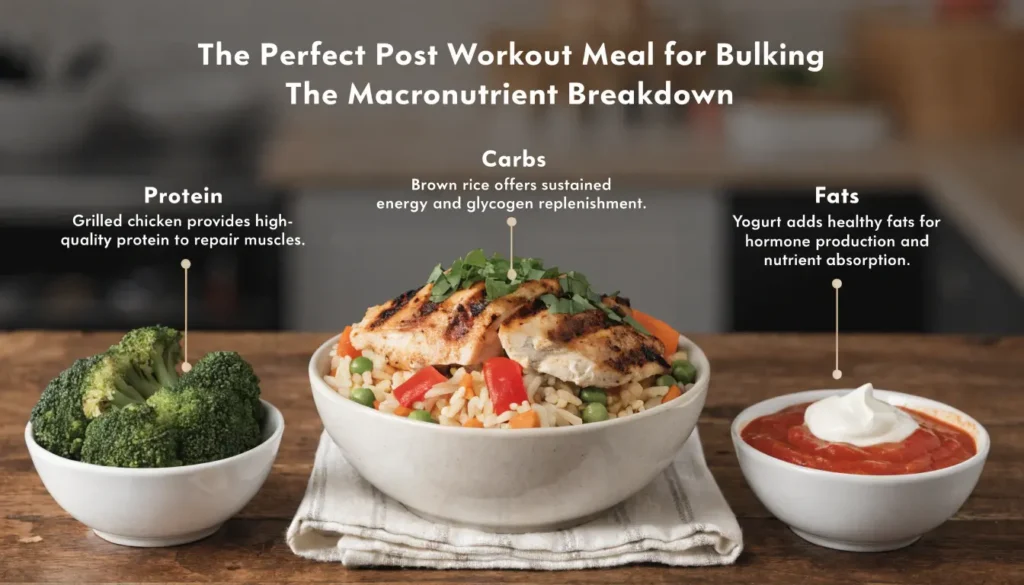
Here’s where we get practical. Building your ideal post-training meal isn’t complicated rocket science. It’s more like following a reliable recipe—get the ratios right, use quality ingredients, and trust the process.
Protein: The Building Block
Let’s start with the non-negotiable. Protein provides the amino acids that directly repair those micro-tears you created during training. Without enough of it, your body simply cannot rebuild. It’s like showing up to a construction site with no bricks.
For most people bulking effectively, the sweet spot lands between 20 and 40 grams of high-quality protein in that first post-workout meal. But here’s the nuance that matters:
Fast-digesting options work best immediately after training. Whey protein isolate remains the gold standard here—it hits your bloodstream quickly, spikes leucine levels (that’s the amino acid that actually triggers muscle protein synthesis), and gets to work fast. Eggs work similarly. Liquid forms digest rapidly, which matters when your muscles are starving.
Slower options have their place too. If you’re eating a whole-food meal an hour or two after training, chicken breast, lean beef, fish, or Greek yogurt provide sustained amino acid release. They keep the building process going longer.
The math is straightforward: multiply your target body weight by 0.4 to 0.5 grams. That’s your post-workout protein target. For a 180-pound lifter, we’re talking 70 to 90 grams across that first meal and the one that follows a few hours later.
Carbohydrates: Recharging Your Batteries
Here’s where many people—especially those carrying old diet baggage—get stuck. They limit carbs after training, worried about fat gain or insulin or some outdated nutrition dogma.
Stop that right now.
Post-workout carbs are not your enemy. They’re your most powerful tool for growth.
During bulking, your body needs glycogen replenishment to support recovery and prepare for your next session. The general guideline of 0.5 to 0.7 grams of carbs per pound of body weight works well for most lifters. For that same 180-pound person, we’re looking at 90 to 125 grams of carbs in that post-training window.
Simple carbs have a real purpose here. White rice, potatoes, white bread, and fruit digest quickly and spike insulin beneficially. That insulin spike—again, usually framed negatively—helps drive amino acids and glucose directly into muscle cells. It’s exactly what you want right now.
Complex carbs matter too, just slightly later. Oats, sweet potatoes, and quinoa provide sustained energy release. They’re perfect for the whole-food meal you eat a couple hours after training, keeping you in an anabolic state longer.
Fats: Handle with Care
I need to be honest with you about fats. They’re essential for hormone production—testosterone literally requires dietary fat to be synthesized—but they have a complicated relationship with post-workout timing.
The issue isn’t that fats are bad. The issue is digestion speed. Fats slow gastric emptying, meaning everything you eat stays in your stomach longer. When your muscles are screaming for rapid nutrient delivery immediately after training, that’s counterproductive.
Here’s my practical advice: keep fats minimal in the immediate post-workout window. Save the avocado, nuts, and olive oil for meals later in the day. That doesn’t mean avoiding them entirely—just being strategic about when they enter the picture.
5 Examples of Powerful Post Workout Meals for Bulking
Enough theory. Let’s talk about what this actually looks like on your plate. These meals are tested, practical, and designed to hit those macro targets without requiring gourmet cooking skills.
The Classic Bodybuilder’s Choice
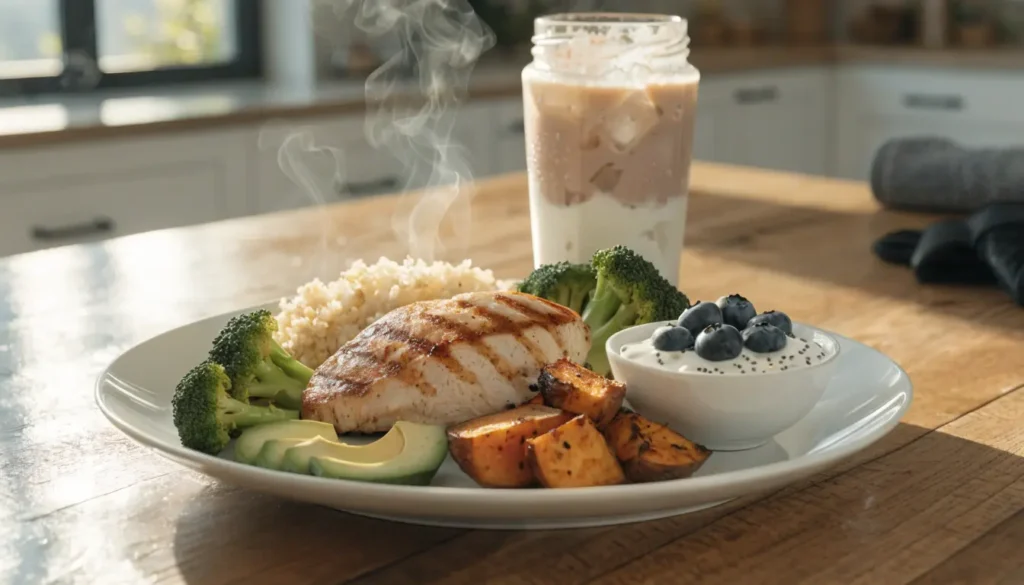
Two grilled chicken breasts. One and a half cups of white rice. A solid portion of steamed broccoli.
This combination has built more physiques than probably any other meal in lifting history. The chicken provides lean, complete protein. The white rice digests quickly and replenishes glycogen efficiently. The broccoli adds micronutrients and fiber without interfering with digestion speed. It’s simple. It works. You can prep it in bulk and eat it consistently without overthinking.
The Quick and Easy Shake
Two scoops of whey protein. One cup of rolled oats. One whole banana. Water or milk to blend.
This is your immediate post-workout option—the one you drink while still sweating, ideally within thirty minutes of your last set. The whey hits fast. The oats and banana provide quick-digesting carbs. It’s liquid, so absorption happens rapidly. And it’s portable, which matters when you have a commute or other obligations after training.
The Seafood Powerhouse
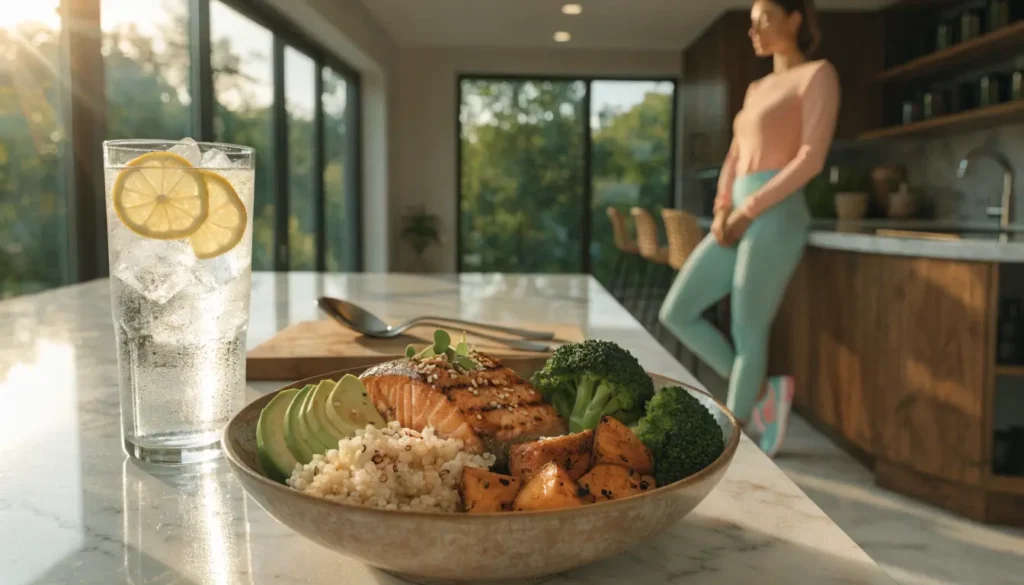
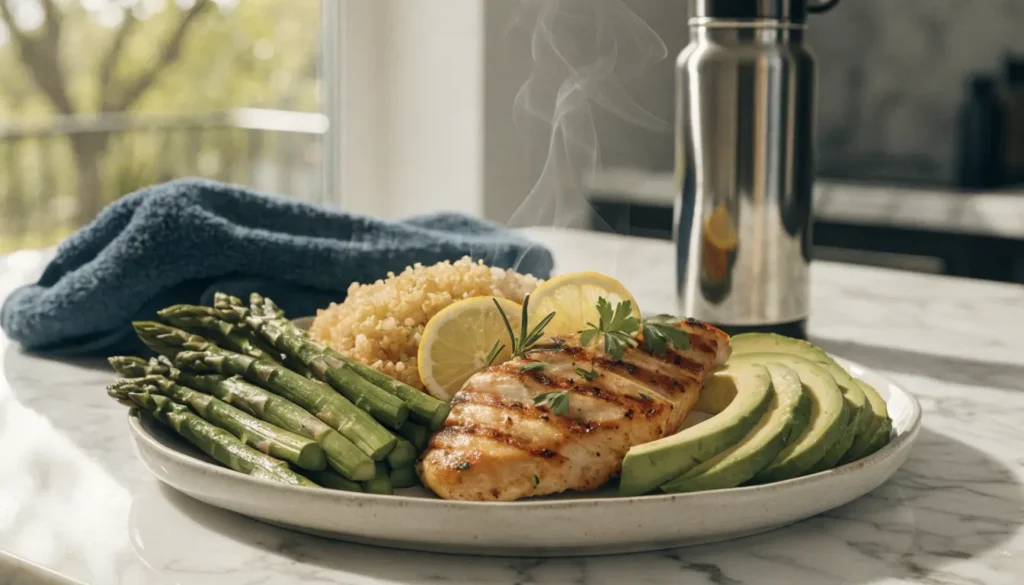
Eight ounces of grilled salmon. One and a half cups of quinoa. Asparagus on the side.
Salmon brings protein plus omega-3 fatty acids that help control inflammation—useful when you’re training hard and accumulating joint stress. Quinoa offers complete protein and steady-digesting carbohydrates. This meal works best about ninety minutes post-workout, after the immediate window has passed but while your muscles still crave nutrients.
The Red Meat Feast
Six ounces of lean sirloin steak. Two medium baked potatoes, skin on. Green beans.
Red meat provides natural creatine, zinc for testosterone production, and iron for oxygen transport. Potatoes deliver potassium (you lost electrolytes sweating) and rapid glycogen replenishment. This is a denser meal, perfect for later in the day when you have time to digest fully.
The Vegetarian Option
One cup of cottage cheese. One cup of cooked quinoa. Black beans mixed in. Salsa for flavor.
Cottage cheese offers slow-digesting casein protein. Quinoa and black beans combine to form complete amino acid profiles. This meal sustains protein synthesis for hours, making it ideal for the meal after your immediate post-workout shake.
Timing and Frequency: When to Eat for Maximum Growth
Let’s address the timing question that confuses so many lifters.
The Immediate Window
That “thirty-minute anabolic window” concept got overhyped years ago. The reality is more forgiving but still important. Your muscles remain highly receptive to nutrients for about two hours after training. The first thirty minutes represent peak receptivity, but you haven’t missed your opportunity if you eat at sixty or ninety minutes.
Option A for immediate nutrition: A liquid meal. Shake, fast carbs, maybe some fruit. This hits your bloodstream quickly and starts the recovery process immediately. It’s particularly valuable if you train fasted or early in the morning.
Option B within two hours: A whole-food meal matching the examples above. This provides sustained amino acid release and keeps you in an anabolic state longer than liquids alone.
The Two-Meal Approach
Here’s a strategy that works exceptionally well for serious bulkers:
Meal one, immediately post-workout, focuses on fast-digesting protein and carbs. Liquid form preferred. This stops muscle breakdown quickly and starts the rebuilding process.
Meal two, two to three hours later, provides whole-food protein and complex carbohydrates. This extends the anabolic state significantly, keeping your body in building mode for hours rather than minutes.
This approach leverages the best of both worlds: rapid initial response plus sustained support.
Optimizing Your Post-Workout Nutrition: Supplements vs. Whole Foods
You’ll hear strong opinions on both sides of this debate. Let me give you the practical truth that actually works in real life.
| Aspect | Whole Foods | Supplements |
|---|---|---|
| Nutrient density | Complete packages with vitamins, minerals, fiber your body recognizes | Usually fortified but missing the complexity of real food matrices |
| Digestion rate | Slower, more sustained release | Fast, ideal for immediate window |
| Satiety | Keeps you full longer | Easy to consume without feeling stuffed |
| Convenience | Requires planning and prep | Grab-and-go friendly |
| Best application | Main meals 2+ hours after training | Immediately post-workout or when whole food isn’t possible |
The winning strategy uses both intentionally. Your post-workout shake hits immediately after training—that’s its strength. Your whole-food meal follows later—that’s its strength. Trying to replace one completely with the other usually creates problems. Relying only on shakes leaves you missing micronutrients and sustained release. Relying only on whole foods misses that rapid initial window.
Use the shake immediately. Eat real food afterward. Both serve distinct purposes.
Frequently Asked Questions About the Post Workout Meal for Bulking
Is a post workout meal necessary for bulking, or can I just drink a shake?
Here’s the honest answer: a shake works great for immediate recovery. It absorbs fast, hits your bloodstream quickly, and starts the process. But it shouldn’t stand alone. For optimal bulking, combine the shake immediately after training with a whole-food meal a couple hours later. The shake catches the early window. The meal sustains it. Together, they outperform either approach alone.
What if I workout late at night? Should I still eat a big post workout meal for bulking?
Yes, eat something, but adjust the composition. Fast-digesting protein works well—casein actually digests slowly, making it ideal before sleep. Greek yogurt with berries provides protein without heaviness. A protein shake with milk similarly works. Save the massive steak and potato meal for earlier training sessions. Sleep quality matters for recovery, so don’t sabotage it with a meal that keeps you awake digesting.
Can I build muscle without a post-workout meal?
Technically yes, if your total daily calories and protein hit targets. But you’re leaving results on the table. Strategic post-workout nutrition accelerates recovery, reduces soreness, and creates a more favorable anabolic environment than spreading those same nutrients randomly through the day. For efficient bulking—getting the most results from your effort—post-workout nutrition isn’t optional.
How many calories should my post workout meal for bulking have?
This depends on your total daily intake, but a practical guideline targets 20 to 25 percent of your daily calories in that post-workout window. On a 3,000-calorie bulking diet, that means 600 to 750 calories heavily weighted toward protein and carbs. Adjust based on your individual needs and how your body responds.
What if I’m not hungry after training?
This happens frequently, especially after intense sessions. Your body diverted blood flow away from digestion during training, and appetite can temporarily disappear. Don’t let that trick you into skipping nutrition. Liquid options solve this problem—shakes go down easily when solid food feels impossible. Drink your post-workout nutrition, then eat solids when appetite returns.
How soon before training should I eat?
Three to four hours before training works well for a full meal. If you’re closer to training time, reduce portion size and focus on easily digestible carbs with moderate protein. The goal is entering your session fueled but not digesting a heavy meal.
Consistency is the Key to Growth
Here’s what I wish someone had told me years ago, back when I was spinning wheels and wondering why nothing changed:
One perfect post-workout meal won’t transform your physique. Neither will one missed meal destroy your progress. What matters—the only thing that actually matters over time—is consistency. Doing the right thing most of the time, meal after meal, week after week, month after month.
That first time I dialed in my nutrition and actually felt my muscles recover fuller and stronger than before, something clicked. I realized the gym was only half the battle. The other half happened in my kitchen, with my food, my planning, my consistency.
Your post-workout meal for bulking isn’t just fuel. It’s the bridge between effort and results. It’s where hard work turns into visible change. It’s the daily appointment with growth that separates those who build from those who just show up.
So here’s my call to action for you: take what you’ve learned here and actually use it. Plan your post-workout nutrition before your next training session. Have that shake ready. Know what whole-food meal follows it. Treat this with the same importance you give your training.
Because you’ve already proven you can do the hard part. You show up. You push. You grind.
Now show up for the other half. Feed those muscles. Build that body. Turn your effort into something you can see in the mirror.
Your next workout is waiting. And this time, you’ll be ready for what comes after.