You know that moment when you’re st&ing in the grocery aisle, sushi-grade salmon in your cart, ready to recreate your favorite restaurant meal at home? Your h& reaches for that familiar bottle—the one with the red cap you’ve been grabbing since college—when suddenly you freeze. Wait. Is soy sauce gluten free? And why has no one ever mentioned this before?
I spent fifteen minutes staring at bottles in that aisle last spring, phone in h&, scrolling through forum posts that contradicted each other. One website said all soy sauce contains wheat.

Another claimed traditional brewing removes gluten. A third insisted tamari was the only safe option. The confusion was maddening, especially since I’d been accidentally consuming who-knows-what for months.
Here’s the reality check I wish someone had given me back then: navigating gluten-free eating isn’t about memorizing a list of forbidden foods. It’s about underst&ing what actually goes into the products you use daily. And soy sauce? This seemingly simple condiment has a story worth knowing—especially when your health depends on getting it right.
What Exactly Is Traditional Soy Sauce Made Of?
Let’s start with the basics. Soy sauce has been around for over 2,500 years, originating in China before spreading throughout Asia & eventually l&ing in kitchens worldwide. But here’s what most people don’t realize: the recipe has remained remarkably consistent across centuries.
The Four Traditional Ingredients
When you crack open a bottle of traditionally brewed soy sauce, you’re consuming a precise combination of four elements:
- Soybeans – These legumes provide the protein foundation & contribute to that unmistakable umami punch. They’re soaked, steamed, & sometimes roasted before fermentation begins.
- Wheat – This is where things get complicated for anyone avoiding gluten. Wheat berries are typically roasted & crushed, then combined with soybeans. The wheat adds sweetness, feeds the fermentation culture, & contributes to the sauce’s complex aroma.
- Salt – Beyond flavor, salt acts as a natural preservative & controls which microorganisms thrive during the aging process. Without sufficient salt, harmful bacteria would multiply instead of the beneficial ones you want.
- Water – The medium that allows all these ingredients to mingle & transform over time. Water quality actually matters significantly—many traditional breweries pride themselves on specific water sources.
The Fermentation Process & Why Wheat Matters
Here’s where things get interesting. You might wonder why wheat sticks around in soy sauce production when plenty of fermented foods get by without it.
The process typically begins with koji—a mold culture (Aspergillus oryzae) cultivated on steamed rice or, in soy sauce production, on a mixture of soybeans & wheat. This koji breaks down proteins into amino acids & starches into simple sugars. The wheat provides an ideal surface for the koji to grow, while its starches fuel fermentation.
Without wheat, the entire character of the sauce changes. You lose that subtle sweetness, that complex aromatic quality, that depth that makes soy sauce more than just salty liquid. Traditional brewers aren’t adding wheat as a cheap filler—they’re including it because generations of refinement have shown that wheat creates the best possible product.
But here’s the bottom line: because wheat serves as a primary ingredient in traditional brewing, st&ard soy sauce absolutely contains gluten. There’s no processing step that removes or neutralizes gluten proteins. They remain intact throughout fermentation & end up in every drop you pour.
Is Soy Sauce Gluten Free in Its St&ard Form?
Let me be direct with you: conventional, traditionally brewed soy sauce is not gluten free. This isn’t a gray area or a matter of interpretation. If you pick up a bottle of Kikkoman, Yamasa, or most generic store br&s without checking labels carefully, you’re consuming wheat.
The Gluten Content in Popular Soy Sauce Br&s
To give you a practical reference point, here’s how common options break down:
| Br&/Type | Gluten Status | What You Need to Know |
|---|---|---|
| Kikkoman Regular | Contains gluten | Brewed with wheat as a primary ingredient; their gluten-free version is clearly labeled |
| La Choy | Gluten free | Made from hydrolyzed soy protein without wheat; widely available in regular grocery stores |
| San-J Tamari | Usually gluten free | Most varieties are wheat-free, but always verify the specific bottle |
| Pearl River Bridge | Contains gluten | Common in Asian markets; assumes wheat content unless labeled otherwise |
| Generic “Soy Sauce” | Usually contains gluten | Without specific labeling, assume it has wheat |
I’ve made the mistake of assuming “soy sauce” simply meant soybeans. It doesn’t. The term itself, in conventional usage, implies a wheat-containing product. This misunderst&ing trips up countless people new to gluten-free eating.
Why Wheat Is So Commonly Used
You might still be wondering: if wheat causes problems for so many people, why hasn’t the food industry moved away from it?
- Flavor expectations – Consumers have developed specific taste associations over decades. That recognizable soy sauce flavor profile relies on wheat fermentation byproducts. Remove the wheat, & you get something that tastes noticeably different.
- Cultural tradition – Japanese & Chinese brewing methods have used wheat for centuries. Changing these recipes isn’t just about ingredients; it’s about preserving culinary heritage.
- Production efficiency – Wheat provides reliable, consistent fermentation results. Pure soybean fermentation can be trickier to manage & may yield more variable products.
- Cost structure – While not the primary driver, wheat does cost less than soybeans in most markets. A wheat-inclusive product can be produced & sold more affordably.
Underst&ing these factors helps explain why gluten-free alternatives exist as specialized products rather than replacements. The market hasn’t ignored your needs—it’s responding with dedicated options designed specifically for people avoiding gluten.
Types of Gluten-Free Soy Sauce Alternatives
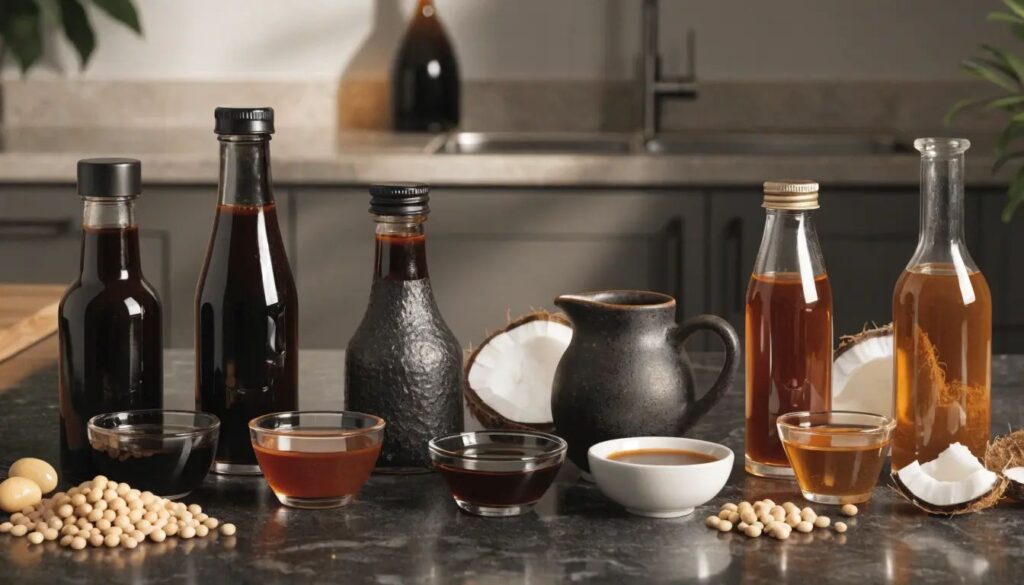
Now for the encouraging part: you have more choices than ever. The gluten-free food boom has brought exceptional alternatives to mainstream availability, & many of them deliver remarkable flavor.
Tamari: The Gluten-Free Champion
If you want the closest possible match to traditional soy sauce, tamari deserves your attention. This Japanese condiment originated as a byproduct of miso paste production—the liquid that separates from fermenting soybeans.
Tamari differs from st&ard soy sauce in several meaningful ways:
- It traditionally contains little to no wheat, relying almost entirely on soybeans
- The flavor profile is richer, darker, & more complex
- It typically has higher viscosity & lower sodium content
- The umami concentration often exceeds st&ard soy sauce
Critical warning: Some commercial tamari br&s add wheat to reduce costs or modify flavor. San-J offers reliable wheat-free options, but you must verify each bottle’s label. Don’t assume “tamari” automatically means “gluten free.”
Liquid Aminos: A Different Take
You’ve probably seen Bragg’s Liquid Aminos in health food stores or the natural foods section. This product takes a completely different approach to achieving savory flavor.
Liquid aminos result from treating soybeans with an acid solution that breaks down proteins into amino acids—the building blocks that create umami taste. No fermentation occurs. No koji cultures develop. The process resembles what happens during digestion, chemically pre-digesting the soy proteins.
What does this mean for you?
- No gluten ingredients are involved in production
- The flavor is sharper & less complex than fermented sauces
- It works beautifully for cooking but tastes slightly different straight from the bottle
- Sodium content varies by br&—Bragg’s runs about 160mg per teaspoon
Coconut Aminos: The Paleo Favorite
Here’s an option that surprised me when I first tried it. Coconut aminos come from fermented coconut sap mixed with sea salt. Despite the name, they don’t taste like coconut—the fermentation process transforms the sap completely.
Why coconut aminos might work for your kitchen:
- Naturally gluten free & soy free (ideal if you avoid both)
- Significantly lower sodium than traditional soy sauce
- Slightly sweet, mild flavor profile
- Popular in paleo, Whole30, & autoimmune protocol communities
- Works well in marinades, dressings, & stir-fries
The main trade-off: if you’re seeking that sharp, salty, fermented punch of traditional soy sauce, coconut aminos won’t deliver it. Think of them as a related but distinct condiment rather than a direct replacement.
Certified Gluten-Free Soy Sauce Options
Several major manufacturers now produce explicitly labeled gluten-free versions of traditional-style soy sauce:
- Kikkoman Gluten-Free Soy Sauce – Made with soybeans & rice instead of wheat; tastes remarkably close to the original
- San-J Gluten-Free Tamari – Available in various formulations including reduced sodium & organic
- VH Gluten-Free Soy Sauce – Common in Canadian markets; offers good availability
- Ocean’s Halo Gluten-Free Soy Sauce – Found in many US grocery chains
These products typically cost more than conventional soy sauce, but the price difference reflects dedicated production lines, separate facilities, & certification costs—not price gouging.
How to Identify Gluten-Free Soy Sauce at the Store
Let me walk you through what I’ve learned about navigating the grocery store sauce aisle. With practice, this becomes second nature.
Reading Labels Like a Pro
Train your eyes to spot these indicators immediately:
- “Gluten-Free” certification – Look for logos from GFCO (Gluten-Free Certification Organization), NSF, or similar third-party verifiers. These indicate actual testing & facility inspections.
- “Made with rice instead of wheat” – Some br&s explicitly market their alternative formulation. Kikkoman’s gluten-free version prominently features this distinction.
- “Tamari” with verification – While tamari often means wheat-free, you still need to spot a gluten-free claim or scan ingredients.
- “No wheat ingredients” – This statement helps but doesn’t guarantee freedom from cross-contamination. For most people with sensitivity, it’s sufficient. For celiac disease, seek certified options.
Red Flags to Watch For
Memorize these warning signs:
- “Hydrolyzed wheat protein” appears in ingredients
- “Contains wheat” in allergen statements
- “Brewed with wheat” on the front label
- “May contain wheat” voluntary warnings
- No allergen information at all (many imported products skip this)
When you encounter a bottle with no clear gluten status & no ingredients list you can verify, the safest approach is choosing something else. That mystery sauce isn’t worth the risk.
Cross-Contamination Concerns in Restaurants & Manufacturing
Finding a gluten-free bottle for home use solves only part of the equation. Eating out introduces entirely new variables.
Hidden Dangers at Sushi Restaurants
Sushi spots present particular challenges because soy sauce use is so integrated into the dining experience:
- Shared table bottles – Those little fish-shaped containers get refilled constantly, with who-knows-what poured in. Even if the restaurant stocks gluten-free soy sauce, it might end up in a container previously filled with regular sauce.
- Communal dipping – Multiple diners dipping sushi into shared sauce introduces trace gluten from whatever they’re eating. Someone’s tempura roll crumbs end up in your supposedly safe sauce.
- Kitchen confusion – Staff may genuinely believe all soy sauce is the same. I’ve been told “yes, it’s gluten free” while staring at a st&ard Kikkoman bottle.
- Hidden soy sauce – Many marinades, glazes, & sauces contain soy sauce as an ingredient. That “teriyaki salmon” likely includes wheat-containing soy sauce unless specifically prepared otherwise.
Practical solution: Ask for individual gluten-free soy sauce packets brought directly from the kitchen. Request that your food be prepared on clean surfaces with clean utensils. If the staff seems uncertain, trust your instincts & choose something else.
Manufacturing Cross-Contamination
Even products labeled “gluten free” can carry trace gluten from shared facilities:
- Some manufacturers produce gluten-free & conventional products on the same lines with cleaning between runs
- Airborne flour particles can settle on equipment & packaging
- Shared storage areas create cross-contact opportunities
For most people with gluten sensitivity, shared facility products work fine. For those with celiac disease or extreme reactivity, seek products labeled “made in a dedicated gluten-free facility” for maximum safety.
Health Implications: Why Gluten Matters for Some People
This section matters because the stakes vary dramatically between individuals. What causes mild bloating in one person triggers autoimmune responses in another.
Celiac Disease & Soy Sauce
For individuals with celiac disease, consuming gluten-containing soy sauce isn’t about discomfort—it’s about preventing intestinal damage. Even small amounts trigger:
- Villous atrophy (damage to nutrient-absorbing finger-like projections in the small intestine)
- Systemic inflammation affecting joints, skin, & organs
- Neurological symptoms including brain fog & peripheral neuropathy
- Increased long-term risks of other autoimmune conditions
- Malnutrition from impaired absorption
The threshold for reaction varies, but many celiac patients react to traces measured in parts per million. That shared sushi restaurant soy sauce container? It poses genuine risk.
Non-Celiac Gluten Sensitivity
Even without celiac disease, gluten-containing soy sauce can trigger significant symptoms:
- Abdominal bloating & cramping within hours of consumption
- Fatigue that feels disproportionate to the meal
- “Brain fog” affecting concentration & memory
- Joint pain without apparent cause
- Skin eruptions or worsening of eczema
- Headaches ranging from mild to migraine-level
The mechanism behind non-celiac gluten sensitivity remains under investigation, but the symptoms feel very real to those who experience them.
Cooking & Substituting with Gluten-Free Soy Sauce
Once you’ve selected your alternative, using it effectively requires minor adjustments to your cooking approach.
Recipe Adaptation Tips
Small changes make big differences when substituting gluten-free alternatives:
- Start with less – Gluten-free options vary in salt concentration. Add gradually & taste as you build the dish.
- Combine umami sources – If your alternative tastes thinner than expected, layer in other savory elements. Mushroom powder, fish sauce, tomato paste, or miso (check gluten status) can add depth.
- Adjust cooking times – Some gluten-free sauces incorporate more sugar or different fermentables, affecting how they behave when heated. Watch for scorching or over-reduction.
- Store properly – Most gluten-free soy sauces last 1-2 years unopened. Once opened, refrigeration extends quality, though some br&s recommend room temperature storage.
Best Uses for Different Alternatives
| Alternative | Ideal Applications | What to Expect |
|---|---|---|
| Tamari | Stir-fries, dipping sauces, marinades | Closest to traditional; rich & balanced |
| Coconut Aminos | Dressings, light marinades, grain bowls | Sweet, mild, lower sodium |
| Liquid Aminos | General cooking, seasoning blends | Sharp, salty, intense |
| GF Soy Sauce (rice-based) | Direct substitution in any recipe | Most similar to original |
Experiment with different options for different purposes. I use tamari for dipping sushi, coconut aminos for salad dressings, & rice-based GF soy sauce for stir-fries. Each serves a purpose.
Frequently Asked Questions About Soy Sauce & Gluten
Is soy sauce gluten free in all Asian cuisine?
No, traditional Asian cooking relies heavily on wheat-containing soy sauce. However, awareness has grown significantly. Many Japanese, Thai, & Vietnamese restaurants now offer gluten-free options or can prepare dishes without soy sauce. Chinese restaurants tend to use more soy sauce overall, making substitutions trickier.
Can I trust “glutamate-free” labels on soy sauce?
Absolutely not—these terms are completely unrelated. “Glutamate-free” refers to MSG (monosodium glutamate), a flavor enhancer. “Gluten-free” refers to the absence of wheat, barley, & rye proteins. A product can be glutamate-free while containing plenty of gluten, & vice versa.
Is there a risk of gluten in tamari?
Yes, despite traditional tamari being wheat-free, some commercial versions add wheat for cost or flavor reasons. Always verify the label includes a gluten-free claim. San-J offers reliable tamari, but other br&s may cut corners.
How much gluten is in regular soy sauce?
Regular soy sauce contains wheat as a primary ingredient, making it completely unsuitable for gluten-free diets regardless of sensitivity level. The gluten concentration is significant—not trace amounts.
Does cooking destroy gluten in soy sauce?
No. Heat does not break down gluten proteins. Cooking may alter the sauce in other ways—thickening it, concentrating flavors, or reducing liquid—but gluten remains intact & reactive throughout.
What about “lite” or “low-sodium” soy sauce?
These varieties still contain wheat unless specifically labeled gluten free. Reduced sodium has no relationship to gluten content. You’re simply getting less salt with the same wheat-based formulation.
Can I use wheat-free tamari in any recipe that calls for soy sauce?
Generally yes, though you may notice flavor differences. Tamari tends to be richer & slightly less salty. For baking or precise recipes, you might need minor adjustments, but for everyday cooking, substitute directly.
Why don’t all soy sauce br&s offer gluten-free options?
Manufacturing truly gluten-free soy sauce requires dedicated equipment, separate facilities, & certification costs. For mass-market br&s serving primarily gluten-consuming customers, the investment often exceeds the return. Fortunately, dedicated gluten-free br&s fill this gap effectively.
Conclusion: Empowering Your Gluten-Free Journey
That afternoon in the grocery aisle feels like ages ago now. I’ve learned to read labels automatically, to ask restaurant staff specific questions, & to keep both tamari & coconut aminos in my pantry for different cooking needs. More importantly, I’ve stopped viewing gluten-free eating as a restriction & started seeing it as an education—a reason to underst& food more deeply than I ever would have otherwise.
The question “is soy sauce gluten free” opens into something larger. It’s really asking: can I trust what I’m putting into my body? Can I enjoy the flavors I love without compromising my health? And the answer, once you know what to look for, is a resounding yes.
You deserve meals that satisfy both your taste buds & your health requirements. You deserve to walk into any grocery store or restaurant with confidence, knowing you can identify safe options. And you deserve to stop worrying about hidden gluten so you can focus on what really matters—sharing good food with people you care about.
Now I’m curious about your experience. Have you found a favorite gluten-free soy sauce alternative? Discovered a restaurant that h&les gluten-free requests exceptionally well? Run into confusion about other condiments? Drop your thoughts in the comments below—your insights might help someone else navigating this same journey.
Here’s to many delicious, confident meals ahead. You’ve got this.